
John Coltrane wasn’t born in Philadelphia, but we can claim him as the city where his musical identity was forged.
“Game knows game,” is the slightly incongruous way that 6abc morning anchor Tamala Edwards described Coltrane’s apprenticeship years in Philly at the “Coltrane 100: Legacy″ concert on Wednesday night. “Iron sharpens iron.”
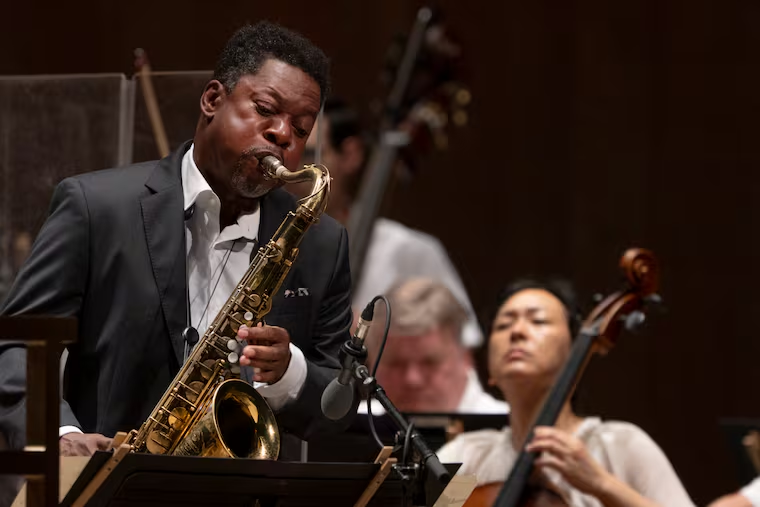
The indelible music that emerged from that honing process was honored by the Philadelphia Orchestra at the Highmark Mann Center. An early celebration of the legendary saxophonist’s 100th birthday (which actually falls on Sept. 23), the concert featured Trane’s son, saxophonist Ravi Coltrane, backed by the Fabulous Philadelphians on an evening of newly orchestrated renditions of pieces written by and associated with his father.
Composer Carlos Simon curated the program, enlisting a host of arrangers to reinterpret Coltrane classics in a symphonic setting. The repertoire spanned much of the saxophonist’s career; from his tenures with Thelonious Monk and Miles Davis to later masterpieces like “A Love Supreme.”
A break in the summer’s unrelenting heat greeted the Orchestra at the Mann, virtually just across the Schuylkill from the Coltrane home in Strawberry Mansion — itself undergoing a major renovation in time for a yearlong centennial celebration kicking off in September. The breezes greeted a modest crowd that made up for lack of numbers in vigorously voiced enthusiasm, especially during the evening’s most bombastic moments — an acrobatic “Giant Steps” and the precision, program-closing “Impressions” greeted with roars.
The night’s loudest ovation may have been reserved for native son Johnathan Blake, the drummer in Coltrane’s stellar quartet. Blake’s father, violinist John Blake Jr., was a regular collaborator with McCoy Tyner, pianist in the revered John Coltrane Quartet, providing another direct connection to the Legacy in the program’s name.
Ravi Coltrane was less than two years old when his father died. At 60, he’s reached an age two decades older than his father ever achieved, and boasts an estimable career of his own. He could be forgiven for being ambivalent about the elder Coltrane’s looming shadow, but he played passionately throughout his first encounter with Simon’s orchestral program.
Past iterations have featured soloists like saxophonist Joe Lovano and trumpeter Terence Blanchard.
If John Coltrane’s place among the pantheon of 20th-century musical masters seems assured, many of the arrangers seemed determined to place him in conversation with other luminaries.
Steven Feifke’s take on “Giant Steps” began with a Wagnerian flourish, while Andy Milne couched “Acknowledgement,” the first movement of “A Love Supreme,” in horns that dawned like a Copland pastorale over harp shimmers. Monk’s “Crepuscule with Nellie,” again arranged by Milne, seemed to navigate through Leonard Bernstein’s midcentury cityscapes.
As is so often the case with jazz-meets-classical hybrids such as this, the Orchestra was often relegated to set dressing for the soloists. Did those famed strings really add anything but volume to the stabs of “So What” or “Blue Train”? Was the profound ballad “Naima” helped or hindered by the sentimental swells swathing its incisive melody?
Simon took the greatest chances with his own arrangements.
Duke Ellington’s “In a Sentimental Mood,” which Coltrane recorded with its composer in 1962, seemed to ripple through the ensemble underneath Ravi’s aching statement of the melody. The fervent protest piece “Alabama,” penned in response to the 1963 16th Street Baptist Church bombing in Birmingham, felt aptly stark and dramatic, fueling Ravi’s raw-edge, impassioned soloing.
Many of the concert’s highlights arrived in similar moments of alchemy between composition, orchestration, and musicians. Arranger Tim Davies’ use of lush horns seemed to imagine “Central Park West” as an early morning reverie in the park, which Ravi and pianist David Virelles picked up in their solos as if on meditative strolls — the saxophonist’s a hazy daydream, the pianist’s a solemn rumination.
At times Ravi directly evoked his father’s voice, beginning his solo on “So What” with a direct quote, weaving his solo on “Acknowledgement” out of ideas from the entirety of “A Love Supreme.”
Virelles took a different approach, conjuring striking moments of abstraction from sudden dissonances and violent clusters, or jarring hints of his Cuban roots. Ravi’s playing on “In a Sentimental Mood” approached it as haunting echoes of the blues; Virelles played with a bold understanding of the deep melancholy undergirding Duke’s elegance.
Ravi Coltrane called it an honor to perform with “one of the greatest orchestras in the history of the world.” The feeling appeared to be mutual, and whatever the balance of cohesion and collision between the two, “Coltrane 100: Legacy” proved to be a fitting tribute to an iconic artist.
Read more McGlinchey’s Bar is back on the market as Center City’s pub scene continues to shift