
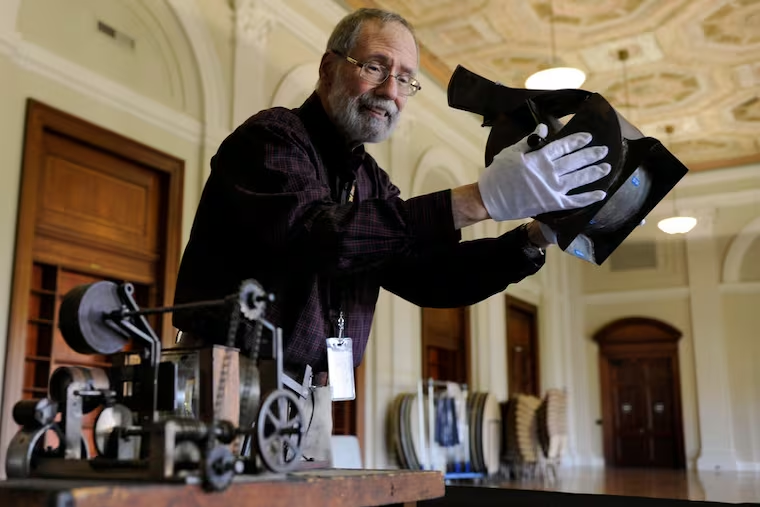
John Alviti, 76, of Flourtown, Montgomery County, retired innovative senior curator at the Franklin Institute, former executive director at the Atwater Kent Museum, adjunct professor of urban studies, and “Mr. Philadelphia History” to family and friends, died Saturday, June 20, of complications from heart and kidney disease at Jefferson Abington Hospital.
Born in Chicago and devoted to history and his South Side White Sox baseball team, Mr. Alviti came to Philadelphia in the 1970s to pursue a doctorate in history and urban studies at Temple University. He never got that doctorate.
But he did fall in love with Philadelphia’s history and architecture, got married, settled down in Flourtown, and, for 34 years, was one of the region’s most influential museum curators and historians. Affable, creative, and energetic, by all accounts, Mr. Alviti became a groundbreaking executive director at the now-closed Atwater Kent Museum in 1982 and celebrated curator at the Franklin Institute in 1994.
Even after he retired in 2018, he was known around town as “Mr. Philadelphia History.”
At the Atwater Kent, Mr. Alviti updated exhibits on William Penn, the history of Philadelphia, the old Enchanted Colonial Village display, and local cemeteries. He added maritime and archaeology galleries.
At a gala to celebrate the museum in 1984, A. Atwater Kent Jr., son of the museum founder, said Mr. Alviti “has done a great job of creating interesting exhibits and improving the museum.”
At the Franklin Institute, he reorganized its huge inventory, redecorated the galleries, digitalized many artifacts, and created popular exhibits regarding the Wright Brothers, Benjamin Franklin, antique machines, X-rays, and dozens of other scientific subjects.
“He loved objects,” said his wife, Maryellen. “He loved the history of objects and telling their story.”
In 1998, Mr. Alviti told The Inquirer: “Besides the curator of stuff, I’m also the curator of institutional memory. And institutional memory is more than just simply the facts about what happened in the past. It’s about the legacy of an institution … and how it informs our thinking and decision-making.”
He was also adept at merging his collections with educational programs, and he helped organize the city’s National History Day competition for students, the Phil-A-Kid hands-on history workshop for fourth- and fifth-graders, the Peopling of Philadelphia research project, and the Curatorial Capers summer day camp program. Often, in a nod to the ever-present protective gloves he wore to handle the artifacts, he introduced himself as “Johnny Whitegloves.”
“There are some curators who think I’m crazy,” he told The Inquirer. But a public presentation, he said, “really demonstrates the power of an object.”
Mr. Alviti also led walking tours of the city for visiting colleagues from the Oral History Association, the Organization of American Historians, and other groups. He admired and worked closely with amateur historians, and led the successful effort in 1981 to save the historic Lit Brothers building complex on Market Street from demolition.
Read more Philadelphia dental clinic reopens two months after patients were urged to get tested for HIV
Between the Atwater Kent and the Franklin Institute, Mr. Alviti spent two years as director of the Historical Society of Washington D.C. He was an expert on public transportation and taught urban studies, American history, and museum training at Temple and Stockton Universities, Rutgers University-Camden, and elsewhere.
He was onetime curator of historic Fort Mifflin and president of what is now the Museum Council of Greater Philadelphia. He was on the advisory board of the old Philadelphia Alliance for Teaching Humanities in the Schools and active with the American Association of Museums and other groups.
“He had a gift for making friends for life,” longtime friend Margaret Marsh said, “and he had a legendary generosity of spirit.” Longtime friend Howard Gillette said: “He never met a stranger.”
John Vincent Alviti was born Sept. 22, 1949. A lifelong avid reader, he earned a bachelor’s degree in urban studies and history at Lewis University in Illinois in 1971 and a master’s degree in history at the University of Wisconsin-Milwaukee in 1975.
He played piano and clarinet, and sang in choirs in high school and college. “He left Chicago when he was 25 or 26,” said his younger sister, Rosemarie Alviti Babic, “but never stopped loving the city.”
He met Maryellen Coonahan when she took an urban studies class he was teaching at Temple, and they married in 1983, and lived in Philadelphia, Washington D.C., and Flourtown. Together, they traveled the world and visited museums in London, Rome, Athens, Madrid, and elsewhere.
Mr. Alviti enjoyed puzzles, games, and conversation. He lived with a heart condition for most of his life and was the lovable “Uncle Johnny” to his nieces and nephews. “He is missed beyond words,” said his niece Lindsay Hogan.
He was fascinated by urban architecture and city life around the world, and he routinely bought food and drink for people without homes, picked up litter, and offered correct directions to those who looked lost.
“He was a curious fellow,” his wife said, “who loved to help people.”
In addition to his wife, sister, and niece, Mr. Alviti is survived by a sister, Rita Jo Alviti Coyne, a brother, James, and other relatives.
A celebration of his life was held earlier.
Donations in his name may be made to Face to Face, 123 E. Price St., Philadelphia, Pa. 19144.
Read more The Philly school board just voted to borrow $600 million to pay its bills