
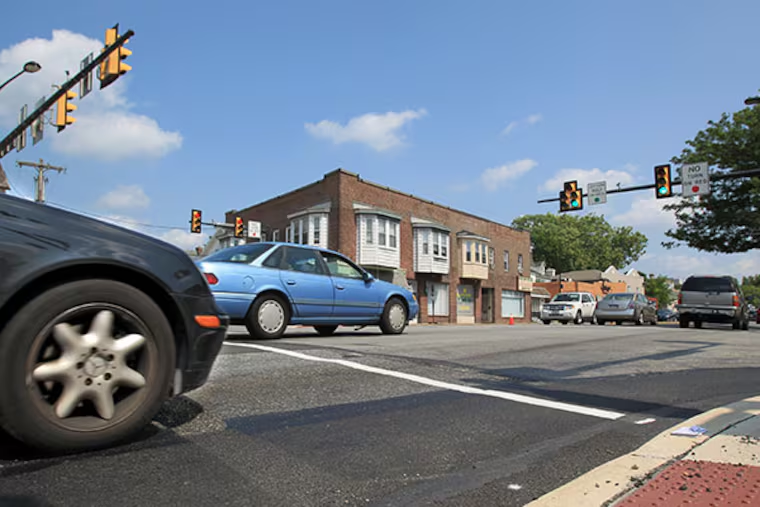
Neck-downs, chicanes, bulb-outs: They sound like threats from a 1930s mobster, but all three are traffic-slowing techniques that could soon arrive on your Abington street.
Read more His Brewerytown house was a splurge, but the low energy use is worth it
The township will now allow residents to request traffic-calming measures under a new policy approved last week that requires traffic studies and majority approval from nearby property owners.
The new petition policy adds to over a decade of efforts to curb speeding in Abington, which was the first town outside of Philadelphia to begin installing red-light cameras in 2014. Abington police have said they saw a resurgence in violations after the department limited in-person traffic stops during the pandemic.
Which streets can get traffic calmers?
To qualify for a traffic-calmer application, a street has to average between 500 and 6,000 vehicles per day on three weekdays in a row and cannot be a major artery or an emergency route. Private roads and alleys aren’t eligible, either, and the road has to be at least 500 feet long.
There are other criteria too, depending on why the traffic-calming tool is needed.
If the issue is speeding, only roads where three-day traffic studies show that over 15% of drivers are going more than 10 miles above the speed limit will qualify.
If cut-through traffic on a sleepy street is the problem, the traffic volume has to exceed the expected level under a formula the township uses, either as a daily average or at its peak.
Who decides which roads get bumps?
There are two ways a road can be evaluated for traffic calmers under Abington’s new policy: a property owner’s petition, or the township manager’s request.
If the manager requests it and a traffic study shows the road meets the criteria, property owners “directly adjacent” to the proposed traffic calmers will get at least 30 days’ notice of the proposal, the traffic data for that road will be posted on the township website, and there will be a two-week public comment period on the plan.
If a property owner submits their road, the police will do a traffic study and ensure it meets the criteria, and then get approval from the township manager to proceed with a petition for approval from local residents. The property owner who filed the request has to get signatures from 60% of the directly affected home and business owners supporting the measure within 90 days.
If approved, the property owner would then pass around a second petition to get 60% to 70% approval from a larger group of affected residents for the specific traffic-calming device and its planned location within 90 days.
Read more Like rival Wawa, Delco’s Swiss Farms plans to add gas pumps under its latest owner
Ticketable speeding not as common as some Abingtonians think, traffic studies show
The traffic study alone may stop many proposals in their tracks, based on similar studies the township already does when residents complain about speeding.
Most studies on the township’s website from 2025 and 2026, spurred by complaints, found very few enforceable speeding infractions.
For example, an October 2025 study at the 500 block of Montgomery Avenue where the speed limit is 25 mph found zero enforceable speeding violations. The average driver was going 18 mph, with 85% going 21 mph or slower.
Many of the dismissed complaints were for roads posted at 25 mph, where going just 9 mph over is 136% of the speed limit.
But some complaints do reflect frequent, enforceable speeding violations: An August 2025 study of the 300 block of Shelmire Street next to Lawnview Cemetery found an average speed of 31 mph in the 25 mph zone, and about 10% of passing vehicles met the criteria for enforcement. The police department planned to add speed enforcement on that block, according to the report.
“Most of our residential streets tend to have 25 mph speed limits,” said Sgt. Michael Coughlin, the traffic safety officer who introduced the new policy at last week’s commissioners’ meeting. “In our experience, people tend to be a little more concerned about speeds where they live, which helps explain some of the complaints.”
What traffic devices could Abington add?
The traffic-calming measures mentioned in the policy include speed humps, roundabouts, road narrowing (called neck-outs), bulb-outs (extended curbs), and chicanes, which create artificial curves in the road with deflectors.
But there are downsides to some devices, township officials have noted at public meetings: Residents might win speed humps on their street, only to realize they now hear the sound of tires thunking over bumps thousands of times per day.

Inquirer Greater Abington
A Weekly Newsletter
Want to get Inquirer Greater Abington straight to your inbox every week? Sign up here for our guide to the news, stories, and events shaping life in your community.
This suburban content is produced with support from the Leslie Miller and Richard Worley Foundation and The Lenfest Institute for Journalism. Editorial content is created independently of the project donors. Gifts to support The Inquirer’s high-impact journalism can be made at inquirer.com/donate. A list of Lenfest Institute donors can be found at lenfestinstitute.org/supporters.
Read more A Queen Village art show is drawing in big crowds with postage stamp-size art