
Procoro Jeronimo, 45, went to his yearly physical in late June. Doctors told him to lay off the bread and replace it with lettuce.
Read more Rob Mac and Wrexham fans take over Subaru Park: ‘It’s just Philly but across the world’
The professional baker was wary, aware that lettuce was linked to an ongoing outbreak — caused by the single-celled parasite cyclospora — causing explosive bowel movements.
Wanting to stay healthy for his five children, he caved, finding solace in not hearing about specific cases in Philadelphia.
A week later, mid lettuce bite, Jeronimo learned that not only was Pennsylvania officially added to the CDC list of the states affected, but also that the outbreak was linked to now-recalled Taylor Farms iceberg lettuce sourced from central Mexico and sold at grocery stores, as well as Taco Bell and other restaurants.
“That was it,” Jeronimo said. “It stopped feeling safe.”
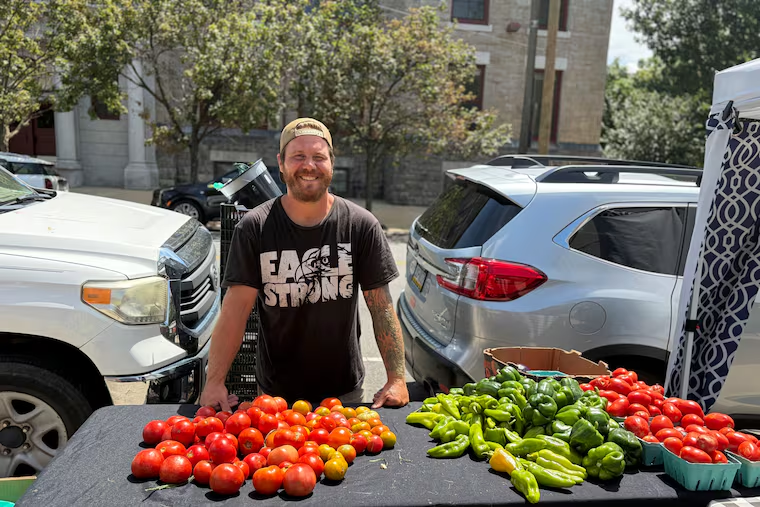
The family ditched their grocery store produce section for the vegetable and fruit stand at the Dickinson Square Farmers’ Market in the city’s Pennsport area.
“It’s hard, because most of our food, like pozole, includes lettuce,” Jeronimo said, checking tomato ripeness in front of farmer Bruce Santino’s stand Sunday morning.
“Lettuce is cheaper at the grocery store; I went from paying $8 to $10 per month for lettuce to paying $20. I guess that is the price for mental peace,” he added.
Jeronimo is not the only one willing to pay more for the feeling of safety. South Philly resident Marie Abbondanza, 42, also abandoned her grocery store produce to walk with her toddler and shop at the farmers’ market.
“We are choosing to get all of our produce from the market because we don’t want to get sick and we want to support the local farmers,” Abbondanza said. “[Grocery stores are] really expensive and their produce isn’t really good, so if we have to pay a little bit more and the quality is better, it’s enough for me.”
So far this year, Pennsylvania health officials confirmed at least 45 cases of cyclosporiasis. That number already surpassed the 40 cases the state experienced in 2025, but still below the 87 reported in 2024.
In the last two to three weeks, Dickinson Square Farmers’ Market has seen the volume of visitors increase by about 15%, said Ben Bergman, 48.
Bergman helps oversee Dickinson Square as well as four other farmers’ markets citywide.
“It looks to be a little safer here because the food is grown closer to you,” Bergman said. “It has less opportunity to become infected with something.”
The increase is being seen by the operators of other farmers’ markets.
According to Bridget Palombo, director of healthy food access programming at the Food Trust, it’s not automatically the case that farmers’ market produce is safer.
“It all depends on the processes that people follow,” Palombo said. “But there seems to be more trust in the products when people can speak to those growing it and bringing it to the market.”
Read more Another flood watch is in effect for the Philly region until late Monday night
The Food Trust operates three year-round markets, three seasonal farm stands, and multiple pop-up markets citywide. Seeing an uptick in foot traffic makes Palombo believe that transparency is a big reason behind the feeling of safety Philadelphians are finding in farmers’ markets.
Farmers’ market visitors get to ask the farmers where their food comes from, what kind of pesticides they used (if any), and how it was harvested.
That transparency does come with a stiffer price tag.
Farmers’ markets are opportunities to purchase directly from producers, allowing the local farms to charge the full, fair cost of production, where corporate farms can cut corners, Palombo said.
“Lettuce from the local farmer has probably traveled only a fifth of the time in and out of cold storage; it’s touched fewer hands; and they are paying their staff livable wages, giving them breaks, and treating them in humane ways,” Palombo said.
At the Dickinson Square Farmers’ Market, farmer Bruce Santino, 38, said he can attest to the care that goes into all of his produce, and how despite the cyclosporiasis outbreak and the uptick in clientele, his business has tried to keep prices steady.
Four people work at his Mullica Hill, Gloucester County, farm, planting and harvesting all kinds of peppers, tomatoes, corn, melons, squash, and leafy greens.
“Only eight hands touch your food, and we harvest the day before the market to get the freshest, highest-quality product,” Santino said.
When they ran the numbers on how much lettuce they would need for this year’s season, they were not expecting a higher demand due to cyclospora.
“As a farmer it’s been tough, because every year you have a crop plan and you do the math of how much you are going to need, then when something like this happens you have to produce as much as you can for the demand,” Santino said.
He was planting and selling 1,200 to 1,500 heads of lettuce per week. Three weeks ago, the business sold almost $1,000 worth of lettuce in one day, he said. But as the staff were planning on upping their production, a couple of days with 100-degree weather fried the lettuce left in the field.
“The little that actually survived was too bitter to harvest and we don’t want to put a bad name on our product, so we prefer to go without it,” Santino said.
His business has already started replanting and plans to produce 30% more lettuce to keep up with the demand. But Santino will keep his price at $3 to $5 per lettuce head.
“I hope we can retain this after the parasite gets taken care of,” Santino said. “I hope people feel safer coming to the local farmers’ market and I hope they taste the difference and stay with us.”