
Lower Merion’s 1,302 parking meters are “slowly failing” and need to be replaced.
That’s according to Gerald Adams, the township’s director of parking services, who last month presented a menu of proposals to Lower Merion’s commissioners as they decide what to do about the community’s collection of aging, and increasingly faulty, parking meters.
Users can feed the meters with coins or reloadable parking smart cards, or they can pay for parking with the ParkMobile app. In addition to the meters and ParkMobile app, Lower Merion’s Cricket Avenue parking garage has six parking kiosks, and the township issues a limited number of parking permits.
The township purchased its now-13-year-old parking meters and replacement parts from POM Parking Meters, a private vendor that went out of business at the beginning of the year. While the township has an inventory of essential parts for repairs and maintenance, it can no longer purchase replacement parts for its meters, making it impossible to fix those that break, according to a briefing compiled by Adams.
The report outlined four potential solutions as Lower Merion’s commissioners make early considerations around the future of parking in the township.
Option No. 1: All new meters
The most straightforward option, according to the briefing, would be to replace all of Lower Merion’s existing meters with new ones from a new vendor. There would be an initial estimated cost of $515,000, and the township would continue to incur the costs of coin collection, which involve personnel costs; parking meter maintenance, which is estimated at $12,000 annually; ongoing replacement of coin collection equipment and backup batteries at $6,000 annually; and the $24,000 annual cost of armored car coin collection.
Option No. 2: App only
The second option would be to remove all parking meters and move exclusively to ParkMobile, the parking app that the township already uses, or a similar app. Removing the meters and installing new signage would cost around $39,000, according to the briefing, and the township would save on maintenance and armored car pickup fees. The parking department could also reexamine its staffing levels and “potentially reduce the number of Parking Maintainers as vacancies occur,” the briefing states.
While this option would make parking enforcement easier for the township, the briefing notes that it would represent a “complete change to how public parking meters are managed in the community” and would require significant education for users.
Option No. 3: App and parking kiosks
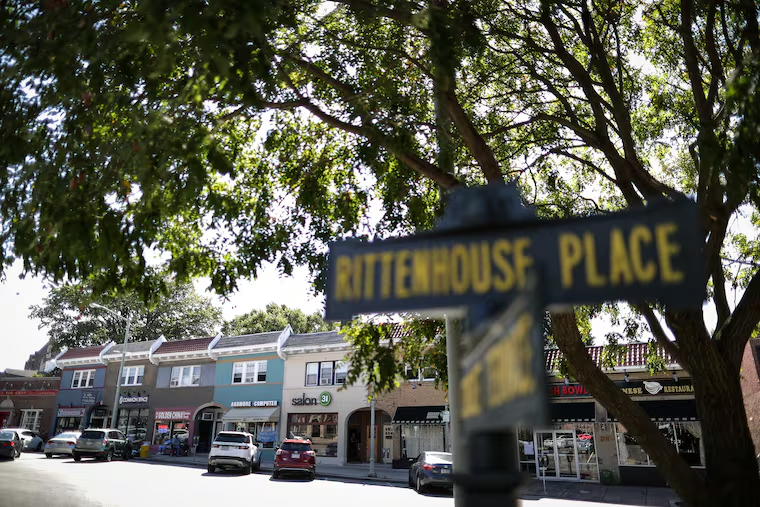
A third option would involve using a hybrid of ParkMobile and parking kiosks. If the township were to use kiosks, staff would recommend starting with 10, which would cost $192,000 in the first year and $90,000 per year thereafter, with an additional $3,000 annually in parts and battery replacements and the cost of taking out the parking meters and adding signage. Kiosks could be placed in high-volume locations like Rittenhouse Place, Schauffele Plaza, and Coulter Avenue.
Read more 150 employees expected to lose jobs as company closes Oaks distribution center
Option No. 4: Phased-out meters, then app only
The fourth option presented by the parking services department would be to “allow the meters to determine their own usefulness” and remove them as they die, allowing the township to slowly phase meters out in favor of an app-only approach. This financial gains of this model would be “slowly realized over several years” and would minimize major expenses on the township’s part.
Commissioners at a July 8 meeting seemed poised to transition to an app-only model, though some raised concerns that relying solely on ParkMobile could present difficulties for people without smartphones or access to credit cards. Adams said ParkMobile offers an option where users can call and pay for parking over the phone, rather than with the app.
Lower Merion collects the majority of its parking revenue through ParkMobile, as usage of the app has slowly eclipsed coins. In 2022, parking revenue in Lower Merion was 40% ParkMobile, 58% coins, and 2% prepaid smart card transactions. By 2025, revenue was 53% ParkMobile, 44% coins, and 3% prepaid smart cards.
Some neighboring communities have moved entirely to app payment, including Conshohocken and West Chester. Radnor uses a hybrid model of ParkMobile and kiosks; Haverford uses ParkMobile and parking meters, which it’s slowly phasing out as the meters break; and Phoenixville uses a combination of kiosks and the Passport Parking App.
The township is in the early stages of the parking meter discussion, an no vote has been taken yet.

Inquirer Lower Merion
A weekly newsletter
Want to get Inquirer Lower Merion straight to your inbox every week? Sign up here for our guide to the news, stories, and events shaping life in your community.
This suburban content is produced with support from the Leslie Miller and Richard Worley Foundation and The Lenfest Institute for Journalism. Editorial content is created independently of the project donors. Gifts to support The Inquirer’s high-impact journalism can be made at inquirer.com/donate. A list of Lenfest Institute donors can be found at lenfestinstitute.org/supporters.
Read more Delco man pleads guilty to stalking Philly TV news personality