
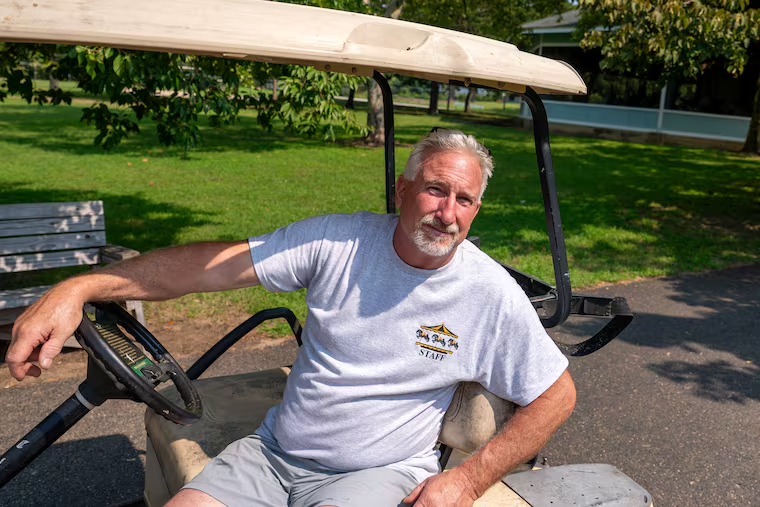
Armando Roberto Perez goes by many names. Armand. Bob. Opa. Mr. Soupy.
Perez, 70, is the longtime caretaker for Soupy Island, a public pool and park in West Deptford, best known for its century-old carousel, free soup, and the tall, enclosed slide guests glide down, crashing into sand.
Read more How Washington learned to pressure Iran without war
Before Perez took the job 28 years ago, his father-in-law was caretaker, and before that, his grandfather-in-law. Managing the former 25-acre haven for sick and hungry kids has long been a family affair.
Soupy Island is open and free to the public three days a week from July to mid-August. For the rest of the year, it’s Perez’s job to keep the tuberculosis treatment center-turned-playground standing come summertime.
He puts the picnic tables away, disconnects the piping and toilets, drains the pool, boards up the carousel, collects leaves, cuts the grass, weed-whacks, handles repairs, and takes on whatever else happens.
“If you’re not self-motivating, nothing’s going to get done,” Perez said.
On Wednesday, the second-to-last day of Soupy Island’s summer and what could be one of Perez’s last seasons as caretaker, 329 people had arrived by lunchtime.
At 11:45 a.m., the park’s amenities close like clockwork for lunch, until 1 p.m. Its 18 staff members ushered children and their families toward the middle of the park for Soupy Island’s controversial intermission: free hot soup, crackers, and milk, enjoyed (or not) in the August heat.
Syreeta Minor, 47, brought her daughter and her group of friends to Soupy Island for the first time after hearing about the destination on YouTube. Minor had no idea the park existed despite living in West Deptford, but she said she’ll likely be back.
A soupy history
Driving his golf cart across Soupy’s campus, Perez explained the park’s complicated history, in brief.
He pointed out the old European carousel, an early 20th-century relic that the National Carousel Association has been working to restore, and all the structures he’s fixed over the years. A chalk drawing made by his granddaughter, Izzy, on the wall of the soup house depicts Perez, “Opa,” at the top of a family tree with his wife, Denise.
The park’s roots trace back to 1877, when the Sanitarium Association of Philadelphia purchased land to create a playground and treatment center for kids with tuberculosis.
The hospital no longer exists, but remnants of its history remain. A public pool has replaced the hospital’s former basement. A brick building from the late 19th century still serves hot soup and snacks from its three windows. The medical staff quarters is where Perez now lives with his wife, free-of-charge, different from the life Perez imagined growing up in North Philly. He graduated from Frankford High School, didn’t go to college, and moved to Jersey when he got married in 1976.
“I came from nothing,” Perez said. “We had government food. We had government housing.”
Perez’s home is an old five-bedroom white house at the front of the park, paid for through an endowment set up by Soupy Island doctors more than a century ago. It’s spacious enough for Perez’s grand and great-grandkids when they visit.
The endowment is what keeps the park alive and has kept it going through decades of turmoil.
During the Great Depression, the Sanitarium Playground fed thousands per day. It was often the only place city children could get a hot meal, by taking a river boat from Penn Treaty pier down the Delaware River. For fun, Perez said, children swam on the river in wool bathing suits and overalls.
In the 1940s, during World War II, the U.S. military took over Soupy Island to protect the nearby shipyard, before the playground returned to its park and soup kitchen roots.
Enjoyed this story?
Get more South Jersey news on your homepage with one click.
‘Working with my hands’
Despite its history, Perez said the island (which isn’t an island at all) has kept under the radar. When staff have to call the police to report vandalism or an incident, they don’t always know where to go.
Read more 🚲 Cycling down the Shore | Outdoorsy Newsletter
“A lot of people don’t know about it. They say, ‘I never knew you were here,’” Perez said. “I got people around the corner who don’t even know we’re here.”
In many ways, that has been to Soupy’s benefit. The summer playground doesn’t have the staffing or space to accommodate huge crowds, and Perez does much of his work solo. Over the years, he’s had to keep up certifications as an amusement ride operator, a pool manager, a lifeguard, and a diver, on top of the mechanical skills he developed over his 24 years at Cherry Hill Volvo.
It was his father-in-law who pestered him to apply for Soupy Island, a career he didn’t want.
“I like working with my hands,” Perez said.
His grandson, Lucas Ngo, plans to take over when Perez retires. A mural of Ngo, now 22, is on the wall over by the big kid pool, painted by Perez when Ngo was still a child.
On Wednesday, Ngo, who originally planned to pursue car mechanic work, prepared the daily soup, chicken noodle, in a giant vat as visitors trickled toward the house. An unfamiliar clanging came from the soup area.
“Now that noise? Open the valve,” Perez instructed, then laughed. “There you go. You get to know the sounds of the things.”
‘A rite of passage’
Lifeguard Ali Bright, 22, placed spoons as Perez scooped soup during Soupy Island’s daily lunchtime ritual. Fellow lifeguard Madi Hogan, 17, carried the trays to a cooling rack, then to the windows to serve a line of people outside.
“It’s like a rite of passage in this family,” said Bright, Perez’ niece. She’s worked at Soupy every summer since she was 14. “This is my little oasis away from my real life.”
The lifelong connection to the playground is typical for staff. Hogan’s great-grandmother used to come to Soupy Island as a child. Marielle Lewis, 17, used to come to the park for soup when she was little, since her aunt lives nearby. Now, she’s worked as a lifeguard for two years.
“It’s kind of weird now that I get to see everything that I wanted to see when I was a kid,” Lewis said.
For now, the group is using their remaining soup supply donated by The Campbell’s Company last year. In the 2000s, the company paid for a new jungle gym, volleyball court, basketball court, and more at Soupy Island and continued its contributions through food since, even though Campbell’s has no true affiliation with the playground despite its name.
But this season, Campbell Soup didn’t donate goods, Perez said, who added that one season’s worth of soup costs the park more than $8,000.
The Food Pantry of South Jersey in Pennsauken has stepped up, though, by giving Soupy Island snack boxes to distribute to visitors.
“Sometimes a lot of these people go through trials, and come in here just to chill a little bit,” Perez said. “You don’t know what the other person’s going through.”
Once Ngo takes over, Perez still plans to help out where he can, just with less physical labor. Plus, he’ll hopefully get to do more home remodeling on the side, and take more consistent naps, his favorite part of the day.
“I try to do it around three,” Perez said, a dream. “But it doesn’t happen.”