
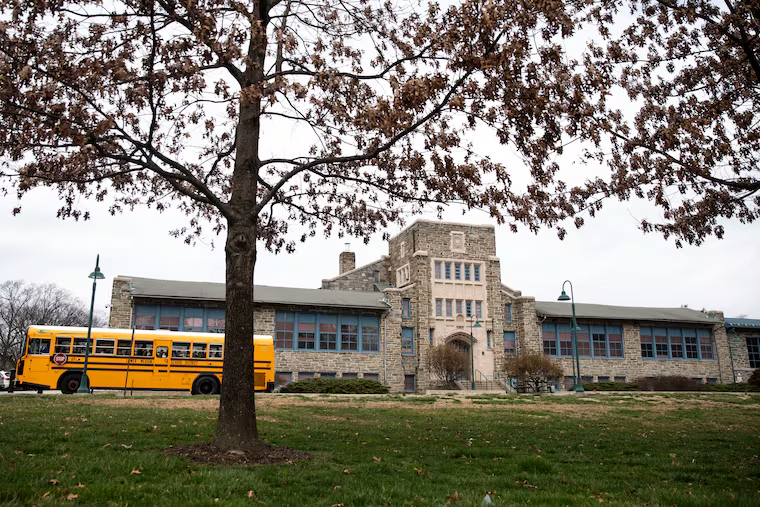
Kindergarteners, first graders and second graders in Lower Merion schools will no longer receive iPads and laptops, under a policy passed by the school board Monday scaling back on students’ technology use.
Read more South Philly’s Tex-Mex mecca Taco Heart is expanding to Ardmore
The policy — which also specifies that third and fourth graders won’t bring computers home and limits’ fifth and sixth graders’ use of computers at lunch and between classes — follows backlash from parents who have been confronting the board since spring about the use of screens in schools. These parents fault the district for providing their kids with devices they say distract them in the classroom, expose them to dangerous content and fail to help them learn.
“We heard legitimate concerns and undertook an unusually significant amount of time to really make substantial change,” Anna Shurak, the board’s policy committee chair, said at Monday’s meeting, noting that the district will also give teachers and parents new tools to monitor what kids are doing on their laptops.
“What we actually will see will be much different when students walk into school this fall,” Shurak said.
The changes come amid increasingly heated debate in the affluent Montgomery County district, as parents nationally demand more say in how their kids interact with technology in schools. A Lower Merion parent group that petitioned this spring for the ability to reject one-to-one devices —a request refused by the district’s superintendent — had urged the board not to adopt the new policy, arguing it didn’t go far enough.
After parents shouted at the board during a meeting earlier this month, it went into recess and moved the meeting online — and announced late last week that Monday’s meeting would be online only, citing disruptions and “threatening comments posted on social media pages.” The district has banned two parents from school board meetings for a year.
“Over the past several months, Lower Merion school board members and our school district superintendent have been subject to threats, our meetings have sustained disruption over and over, and we have witnessed harassment during our public meetings,” school board president Kerry Sautner said at the start of Monday’s meeting, adding that “our school team has had their home and families harassed.”
“This is unacceptable,” Sautner said.
District spokesperson Amy Buckman said that comments posted on the Facebook page for Pencils Over Pixels, the parent group pushing for less technology use, “included calls for both death and doxing of Lower Merion School District leadership.”
The comments “were viewable for approximately 48 hours (and maybe longer),” Buckman said in an email.
In a statement Monday, Pencils Over Pixels said it was “horrified by threatening, violent, or hateful comments directed at board members and district employees.” The group, which has enlisted a public relations firm to help promote its message and has gained national attention, said it did not believe the comments came from its members, and once it became aware of them, “we deleted and reported them.”
The controversy, it said, reflected why they have been pushing back on screens in school.
“What chance do children and teenagers have in this toxic digital environment while their brains, judgment, and emotional regulation are still developing?” the group said.
The district is strengthening its filtering system to block kids from inappropriate sites, and parents will be able to restrict what kids can access on their school-issued devices in their homes, Shurak said.
The new technology policy makes clear that “teachers and relationships are central to learning,” Shurak said. “Technology is a tool, not a substitute for instruction.”
Tech changes by grade level
The new policy ends Lower Merion’s practice of giving devices to kindergartners, first graders and second graders.
In the classroom, any use of devices at those grade levels “shall be minimal, highly structured, and limited to specific educational purposes such as diagnostic testing, whole-class demonstration, visual display, or, if applicable, state testing preparation,” the policy says. (Pennsylvania’s standardized tests, which start in third grade, are required to be done online.)
In grades 3 and 4, students will have “teacher-directed” access to devices that remain in the classroom, while starting in grades 5 and 6, kids will be issued individual devices. But they will stay in classrooms unless parents want their kids to bring them home, according to the policy.
By grades 7 and 8, kids may take their devices to and from school under the policy, though they won’t be penalized for not completing any computer-based homework, district officials have said.
The policy describes giving students increased independence with devices to form “responsible digital habits,” preparing high schoolers for college and careers.
Theresa Doggett, a parent of three children in district elementary, middle and high schools, said the district was making substantial changes.
Because of pushback from parents, “public narrative is making it sound like nothing’s being done,” said Doggett, an administrator at a charter school network in Philadelphia. With help from another parent, she wrote and circulated an open letter to support the board and administrators, that read in part, “Enough is enough.”
“We cannot continue creating conditions in which talented educators and leaders spend disproportionate amounts of their time responding to conflict, personal attacks, and the demands of whichever voices are loudest rather than leading our schools,” the letter says, noting high turnover in Lower Merion’s superintendent job.
Questions about implementation
But in comments submitted via chat and read aloud by the district’s solicitor during Monday’s meeting, parents continued to question how the policy would play out in practice.
Some noted the lack of strict limits on screen time. Administrative rules accompanying the policy list guidelines for how much time students should “typically” spend on devices each day: less than 30 minutes for grades three and four, 60 minutes for grades five and six, 90 minutes for grades seven and eight, and 120 minutes for high school.
The rules also describe “allowing reasonable flexibility based on educational purpose.”
The policy “leaves devices in my seven-year-old’s classroom and sets no enforceable limit on how long she uses them,” said Akshaya Kumar, a lawyer who teaches at Columbia Law School. She also questioned a separate technology safety policy passed by the board Monday, noting it doesn’t require the district to tell parents what it sees while monitoring student devices.
Michael Post, a physician with two children in the district, said he had “never seen a group of people so adamantly disregard what is happening in front of them.”
“The amount of research and data showing educational technology harms to our children are astronomical,” Post said. He called on the district to form an expert panel to advise it on technology use and “eliminate all technology for elementary and middle school.”
One parent expressed an opposite concern — wondering if children would still be able to take home Chromebooks to do accelerated math, and if her fourth grader would have the same chance to learn how to create PowerPoint presentations as her seventh-grade son.
Read more Kennett Square is capping Airbnbs and other short-term rentals to address housing availability
“Our community does not have one perspective on technology,” Shurak said.