
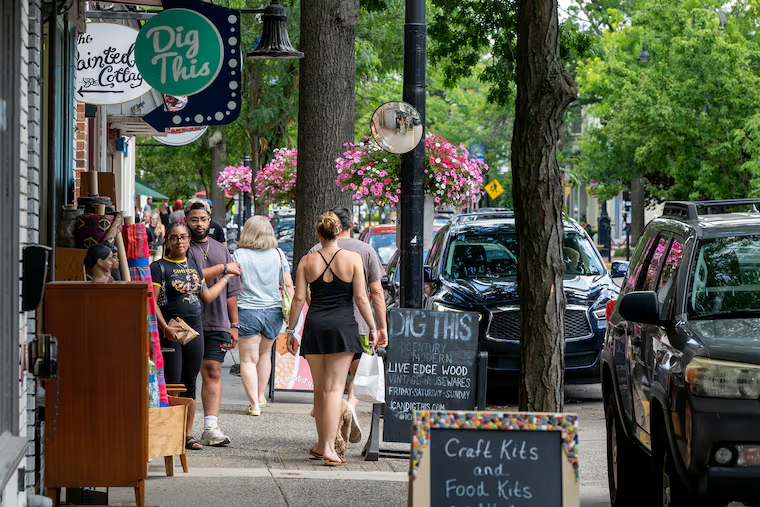
After years of scattered discussion and debate, the future of Collingswood’s long-standing status as a dry town is officially in the hands of voters.
Collingswood’s Board of Commissioners passed a resolution Wednesday to add the question to the borough’s general election ballot in November, just days ahead of the Aug. 21 deadline giving the Camden County Clerk’s Office enough time to put it on the official ballot.
The three-person board was required to adopt the resolution after residents submitted a petition in favor of adding the ballot question that was signed by at least 15% of borough voters who participated in the last general election.
Of the more than 1,100 signatures submitted, the borough verified that 1,019 came from recent Collingswood voters, officials said Wednesday, just eight more than the number of valid signatures required to pass the referendum.
The signatures were collected in a hurry over the last three weeks by Booze on the Ballot, a group of residents who, after years of what they viewed as unproductive back-and-forth on the issue among borough officials, got together to finally give voters the chance to settle the debate one way or the other, organizer Joe Sperlunto said.
The bipartisan group did not explicitly take a position on the issue but rather emphasized this as an opportunity for residents to decide for themselves what they want for the future of their community.
“We’ve just seen it kicked around a lot for a long time and we just felt like it was time for the community to make a decision about it,” Sperlunto said.
Petitioners equipped with clipboards and pens spanned out across town, collecting signatures wherever they could — among the crowds at the popular Saturday farmer’s market, in front of businesses along Haddon Avenue, and even knocking door to door, Sperlunto said.
After formally passing the resolution, Collingswood Mayor Daniela Solano-Ward noted that as Election Day approaches, there will be informational sessions for voters to learn more about this referendum as well as any others that may be on the ballot.
“Just to give everyone the facts and the information,” Solano-Ward said.
“You make your decisions as you wish but we want to make sure that you have information from us as to what is real, what is not real,” she said, before adding, for example, that BYOBs will still be permitted in the borough if liquor licenses are issued, contrary to a popular misconception.
Enjoyed this story?
Get more South Jersey news on your homepage with one click.
What could allowing liquor licenses mean for Collingswood?
Repealing Collingswood’s centuries-old liquor license ban would represent a historic shift for a borough that has prohibited alcohol sales by ordinance since the 19th century, linking back to its Quaker heritage.
Read more Philly is under a flood watch Thursday, and showers are possible into the weekend
If the ban were lifted, the borough would have two options for how to award licenses, borough solicitor Caitlin Harney Norcia said during a commissioners meeting earlier this year.
Collingswood could either award licenses in a competitive bidding process, which could generate one-time revenue for Collingswood’s budget, she said, or the borough could enact an application and review process that includes annual fees and public presentations by prospective licensees.
The number of liquor licenses permitted within the borough is limited by a state-mandated population-based cap. If voters decide to lift the ban, Collingswood could either issue a single distribution license for a liquor store or up to four retail consumption licenses that permit restaurants or bars to serve alcohol.
Annual licensing and renewal fees could generate between $1,000 and $10,000 for the borough each year, Harney Norcia said.
Proponents of lifting the longtime ban see liquor licenses as an opportunity to bolster Collingswood’s local restaurants while generating revenue for the borough.
At the same time, borough administrator Cassandra Duffey previously told The Inquirer that some business owners are worried that existing Collingswood restaurants will be overlooked for licenses awarded through the public bidding process.
If alcohol sales are ultimately permitted, Duffey said the borough will work to not “disrupt the balance” of the borough’s established businesses.
Just a few miles down the White Horse Pike, Haddon Heights is preparing to sell its first retail liquor license at a public auction next month after getting rid of its de facto ban on alcohol sales in 2024.
The efforts in both towns appear to be in line with goals set forth in legislation passed in 2024 by then-Gov. Phil Murphy to increase the availability and affordability of liquor licenses statewide. The measure was touted as an unprecedented reform of New Jersey’s liquor laws, which has been criticized as being arcane and antiquated.