
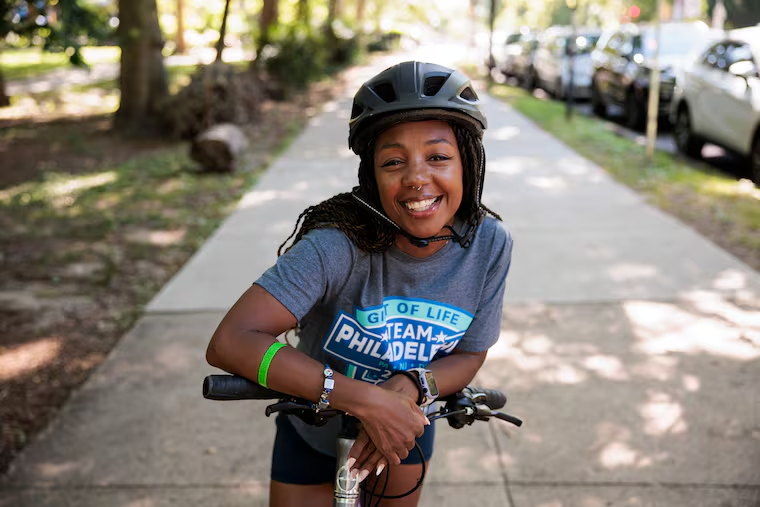
One Team Philly athlete underwent a heart transplant while experiencing homelessness at 14.
Another is on his third organ transplant after a severe case of COVID-19.
And a third received his new heart three weeks after his daughter was born.
All are training to compete starting Thursday through the weekend at the Transplant Games of America, an Olympic-style event for transplant recipients, living donors, and donor families. Held in Denver this year, the competition celebrates organ donation and showcases life after a transplant.
The local nonprofit Gift of Life Donor Program organized Team Philly, whose 86 athletes hail from eastern Pennsylvania, South Jersey, and Delaware. They’re competing thanks to transplants ranging from hearts and lungs to kidneys, livers, and other organs.
The Inquirer spoke to three athletes about their journeys with heart transplantation and motivations to compete.
Childhood as a two-time transplant recipient
Evett Hawks stared at the mirror in awe.
After months looking “white as a sheet,” the West Philadelphia native saw in the bathroom mirror a 14-year-old girl whose cheeks were rosy. Her skin was warm and she could feel her fingers.
“I want to look like this forever,” she recalls thinking.
Hawks, who was born with a hole in her heart, underwent her first transplant at age 3 after a cardiac arrest episode landed her on life support. The donor heart kept her healthy for adecade, until her body started shutting down again in 2006.
Doctors diagnosed her with end-stage heart failure. At the time, she and her mother were living in a shelter without a permanent home.
“Why me?” and “this isn’t fair” thoughts overwhelmed her,as she moved to the Children’s Hospital of Philadelphia to wait for a new heart.
She started to doubt her odds of finding a match as months passed. She watched other pediatric patients die before they could get their own transplants.
“Oh, I’m going to die, too,” Hawks recalled thinking.
After nearly a year at CHOP, doctors found her a heart.
While recovering from her surgery, Hawks saw a little boy who was still on the transplant waiting list walking laps around the hospital floor.
He abruptly stopped in front of her room and said, “I can’t do this anymore. It just is too hard.”
His nurse took him back to his room.
Hawks said to herself, if “he can’t do it, I’m going to do it.”
Now, nearly two decades later, at 33, she will compete in her first Transplant Games in the cycling and singing events. She has trained by biking seven miles to and from her job as a registration specialist at Carvana.
“The goal is just to do my best, and maybe come back with a medal,” she said.
Rebuilding his life after three transplants
Leston Hall Sr.’s heart stopped in December 2022.
Airlifted to Thomas Jefferson University Hospital in Center City, he learned from doctors that he could not leave the hospital withoutheart and kidney transplants. His organs had suffered major damage from an earlier COVID-19 infection.
Hall, who lives in Bridgeton, N.J., had receivedhis first kidney transplant in 2013 due to familial hypertension. At the time, he had an identified donor: his wife, Tonia.
This time, he didn’t know how long he would have to wait for a match.
Then in his 50s, he was so sick he required a scooter to get around. Mostly, he lay in bed.
“I was barely holding on,” he said.
Other patients would invite him out on walks, but he always declined. He finally agreed to go with them one day, thinking, “maybe they’ll leave me alone.”
They became an inseparable group of four that he now considers “family for life.” Their friendship helped him endure the difficult waiting period that lasted until June 2023, when doctors found him a new heart and kidney.
Read more Australia is up next in the USMNT’s World Cup run. Here’s how we think this one will shake out.
After the surgeries, Hall struggled to adjust back to living at home. He hesitated to go down stairs for fear of not being able to get back up, and kept a chair by the stove whenever he cooked.
Over time, he built his leg strength back up using an elliptical machine.
By early August, he was able to cook without the chair. He surprised his wife with a dinner of chicken breast, rice, broccoli, and green beans — the first full meal he cooked since coming home.
Hall celebrated the three-year anniversary of getting his new heart and kidney last week.
At his first Transplant Games this week, he’s set to compete in pickleball, cornhole, basketball, and poker.
Hall said he’s grateful “just to be able to accept that challenge.”
Wanting to see his children grow up
Todd French watched his daughter’s birth over FaceTime in October 2021 from his bed at the Hospital of the University of Pennsylvania.
He had learned he needed a heart transplant earlier that month.
“All I could think about was, ‘I would do whatever to get to watch them grow up,’” he said, referring to his son and newborn daughter.
The teacher from Milford, Del., had exhausted other treatment options for his cardiac sarcoidosis, an autoimmune disease where cells clump up in heart tissue and interfere with its functioning. For eight years, his heart would randomly beat out of control in episodes called “V-tach.”
“It caused the electrical system in my heart to kind of go haywire,” French said.
Doctors placed a defibrillator — a device that shocks the heart back into a normal rhythm — in his chest and conducted ablation procedures. However, the episodes recurred. Each time, the defibrillator would deliver a painful shock that felt like “a mule kick to the chest,” he said.
After suffering 22 shocks in two hours in 2021, he was admitted to the hospital to wait for a transplant.
On Nov. 11, 2021, three weeks after his daughter’s birth, French received a donor heart.
With the help of a personal trainer and cardiac rehab, he rebuilt his lung capacity. Today, he teachesphysical education at Milford High School.
Staying active and healthy is “a respect thing,” he said. “You want to honor the person that helped you and your family.”
At his first Transplant Games in 2024, he won two gold medals in golfing events and a silver medal in Texas Hold’em.
He’s hoping to win the golfing events again this year.
“It gives an opportunity to shine a light on everything that a transplant does for people,” he said.
Read more Is New Zealand becoming the next pinot noir capital?