
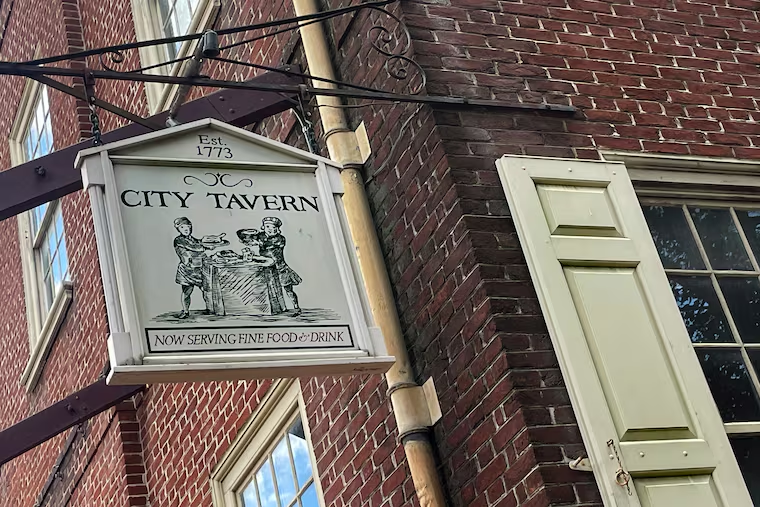
As Philadelphia prepares to welcome visitors for the nation’s 250th anniversary celebrations, one of its most notable historic sites will stir back to life — at least outdoors.
Read more Mayor Parker declares public safety emergency at Bartram Village after squatters cause major damage
Historic Philadelphia Inc., through an agreement with Independence National Historical Park and in partnership with event company Cescaphe, plans to open the Garden at City Tavern on June 25, transforming the shaded plot behind City Tavern into a seasonal destination featuring food, drinks, historical interpreters, lawn games, and special events.
The garden will operate from 11 a.m. to 8 p.m. Thursday through Sunday through Labor Day on the grounds behind the shuttered restaurant at Second and Walnut Streets, offering visitors a chance to gather at a site that played a prominent role in Revolutionary-era Philadelphia.
What visitors will not find, though, is a reopened City Tavern.
The restaurant inside the three-story brick building has been dark since October 2020. Though the closure became associated with the COVID-19 pandemic, former chef-proprietor Walter Staib said the building’s mounting physical problems were the larger issue.
“COVID was the perfect excuse to close, but it wasn’t the real reason,” Staib said Thursday. “The tavern would have closed anyway. The liabilities had become too great.”
The National Park Service sought a long-term operator in 2023, but no successor has been announced. “Lease negotiations are in process, which we hope to conclude by the end of summer,” park superintendent Steven Sims said in a statement to The Inquirer.
For now, Historic Philadelphia is concentrating on the garden.
“We really wanted to activate City Tavern itself,” said Amy Needle, president and chief executive officer of Historic Philadelphia. “The garden has always been a gorgeous space. For now, we’re focusing on that.” She said the seasonal run could be extended if demand remains strong and hopes to bring the pop-up back each summer.
Founded in 1773, City Tavern served as a gathering place for merchants, politicians, and many of the nation’s founders. Delegates to the First Continental Congress dined there, while George Washington, Thomas Jefferson, John Adams, and Benjamin Franklin were among its patrons.
The original structure was damaged by fire in 1834 and demolished two decades later. The current building is a reconstruction commissioned by the park service and opened in 1976 as part of the nation’s Bicentennial celebration.
For decades, City Tavern operated as both a restaurant and a living-history attraction, eventually becoming closely identified with Staib, the German-born chef, historian, and television personality who took over the operation in 1994. Under his stewardship, the restaurant gained national recognition for menus inspired by colonial recipes and traditions, helping launch cookbooks and the PBS series A Taste of History.
Read more The Buttery’s newest outpost is opening in Bryn Mawr this weekend
Staib said many people still contact him, especially around patriotic holidays, asking when the tavern will reopen. “I tell them, ‘I’ve got nothing to do with the tavern,’” he said.
He said he declined an invitation to appear at the garden’s opening, but he would be delighted to advise a new operator. At 80 years old, he said, his days of restaurant ownership are history.
Among the building’s challenges, Staib cited the lack of a sprinkler system in dining rooms, aging infrastructure, and the absence of an elevator. Even before the closure, he estimated that bringing the property into compliance would require millions of dollars. “Add another six years of deterioration,” he said, “and it’s even more expensive now.”
Historic Philadelphia, meanwhile, saw an opportunity to bring activity back to the property. Backed by a grant from the Connelly Foundation, the organization upgraded the garden with new landscaping, seating, and other amenities. It also enlisted Cescaphe — Historic Philadelphia’s partner in other ventures, including Franklin Square — to operate the seasonal pop-up; financial terms of the arrangement were not disclosed.
Despite the historic setting, the food and beverage offerings are decidedly contemporary. The menu includes turkey sandwiches, wraps, charcuterie boards, pretzels, beer, wine, and canned cocktails with names such as Patriots Punch, Birthday Brew, and Liberty Lemonade. Cescaphe will use an off-site commissary rather than City Tavern’s dormant kitchens. Unlike the former restaurant, staff will not wear colonial-era clothing.
Historic Philadelphia’s “History Makers” interpreters will appear regularly at the site, and the organization’s Independence After Hours tours will conclude at the garden on Saturday evenings. During the Historic District’s Red, White & Blue To-Do celebration on July 2, the garden also will host live music.
Needle said the project reflects Historic Philadelphia’s broader mission of bringing activity to public spaces and historic sites.
“The garden is already used by neighborhood residents,” she said. “People walk their dogs there, and visitors come through as well. Part of our mission is bringing these places to life, so we’re excited to do that here.”
Read more The 1966 day in the other Philadelphia that showcased the greatness of Martin Luther King Jr.