
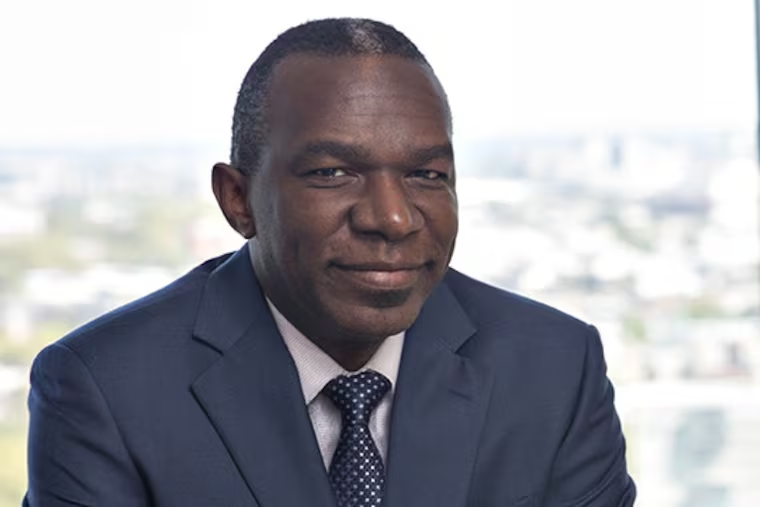
As Philadelphia’s city solicitor, heading a staff of more than 200 lawyers, Sozi Pedro Tulante sued some of the nation’s biggest corporations, accusing them of loan discrimination and pushing lethal painkillers.
Read more Alan Greenspan, most powerful central banker of modern times, dies at 100
Now he’s apartner at Dechert LLP, a Philadelphia-founded, international corporate law firm, where the work includes defending big national corporations from the kinds of complaints he used to file.
Corporate targets during his 2016-18 stint as the city’s top civil lawyer included Wells Fargo & Co., the third-largest U.S. bank, which settled his lending-discrimination complaint for a promise of $10 million in donations to housing programs, and six pharmaceutical companies, four of which were major Pennsylvania employers, for promoting addictive opioids. The city later got a nearly $200 million share of a national settlement.
Tulante’s job also included routine legal reviews. He defended the city’s soda tax and its sanctuary city immigration status.
After leaving his city position in 2018, Tulante — son of a refugee, a Northeast High School and Harvard University graduate, and a former federal prosecutor — lectured at the University of Pennsylvania’s law school.
He joined Dechert’s litigation department the next year, then spent 2022 to 2025 as general counsel at Boston-based Form Energy, which builds iron-based batteries for data centers and other clients at its plant in Weirton, W.Va.
Last year, Tulante moved back to Philadelphia and was named co-managing partner of Dechert’s Philadelphia office. He agreed to talk to The Inquirer about practicing law in Philadelphia.
This interview has been edited for clarity and brevity.
Does Philadelphia’s reputation as a “judicial hellhole” full of billboards urging citizens to sue businesses scare companies away?
When a company is deciding to locate in a particular place, they do look at the tax structure and how red is the red tape and the legal climate.
The Inquirer has reported how in Philadelphia [a plaintiff] can pursue a case in Philadelphia Court of Common Pleas even if they aren’t here. There have been these “nuclear verdicts” for millions of dollars.
More companies are now aware of the risk. They adjust.
There are extreme cases where litigation ends a company. But for the most part you factor it in.
Who gains from a litigious climate?
Sophisticated national companies have clients everywhere. They know they are going to get sued. They study to minimize litigation. For example, don’t use flip messaging. Just be familiar where the threats may come from. Know what litigation the city is pursuing.
Many of the big companies facing litigation in Philadelphia are more likely to engage counsel that is locally respected and recognized in the area. In Philly, if you can’t answer the question, “Where did you go to high school?” [with a name the parties recognize], it’s a disadvantage. Here, we fight the plaintiff attorney, but we also serve on the same board and attend the same continuing legal education [CLE] classes.
There are great lawyers on the other side, at [plaintiffs’] firms like Kline & Specter and Ross Feller Casey, sophisticated counsel who walk into court and get instant respect.
Part of my role at Dechert is to represent clients in Philadelphia and nationally who are thinking about how Philadelphia has changed as a place of litigation and how that litigation impacts business.
Businesses are saying, “We have the tax burden, the regulatory burden, we’ll comply, but you are pushing on the edges.”
What recent laws have changed the legal climate for business?
The new consumer protection ordinance, passed in 2024, has given the city more power to bring some major cases [through national law firms] that are broader than before. Life sciences cases. Firearms liability. Fair workweek litigation. They may go after [national] retailers in certain cases. The city can go forward and get penalties up to $2,000 per violation.
As city solicitor, I was reminded that government has the broadest power of regulation at the local level. The police authority government has is really broad. Unless there’s some preemption by state or federal government. It’s something folks pay attention to.
Is part of Philadelphia’s affordability a result of its failure to attract private-sector employers?
I live in West Philly. I work at the law school. I have three sons in public schools. I want the city to have a secure tax base. I want to make sure investment goes where it needs to.
It’s challenging. One of the biggest challenges is getting people from Temple, Penn, Drexel, and St. Joe’s to stay.
There are instances, like Chubb’s new office, where the city has persuaded [a longtime city employer] to stay.
In Philadelphia the strength ultimately is in eds and meds. We have doctors and nurses, lab technicians, people with a high level of training. Philadelphia takes credit for helping solve COVID by our Nobel Prize winners Drew Weissman and Katalin Karikó at Penn, which has led to investments in gene therapy.
What was the most satisfying thing you did as city solicitor?
Working to get local control of the school district and disbanding the state’s School Reform Commission. It was humiliating, the way the state was running our schools. We should have a stake. The most important thing we can do is educate our children and prepare them for businesses that want to hire talent.
Why did you choose the law?
It’s not the ability to argue that makes a good lawyer. You have to solve problems. You have to be really good at writing. And you have to be able to talk to people — to be personable, to make the hard stuff simple, to help them understand.
I like a career where people ask you to help them solve really big problems. They can be CEO of a major company or a pro bono client that needs a habeas petition. They require the same level of skill.
How did you come to be a Philadelphian?
I came here at age 8 in 1983 [after his father, a military official in Angola, fled to Congo following a change in government, was imprisoned, then was resettled in North Philly by a refugee agency].
It was a difficult time to grow up here. I graduated in 1993 from Northeast High School. I got into Harvard, then Harvard Law School.
Eight years ago, I left the city, to be general counsel at a startup, vowing never to return, except for reunions.
But it came back to family and affordability. Philadelphia is that place for me, within the larger Northeast corridor.
What gives you hope?
My dad drove a cab when he came here. My mom worked in the prison system. Now here I am, a Black attorney from the public school system.
I am a big booster of today’s public schools. My sons are at Central, at Masterman — I couldn’t get into those, I still hold a grudge! — and at Conwell [Middle School] in West Philly.
I want my children with other children who really want to achieve. I motivate them, the teachers motivate them, they are self-motivated, but the friends they are with have more of an impact on them.
And I think we are finally putting into place an infrastructure for understanding government. You know Philadelphia has more political ads and advertising than almost anyplace, a big city in a swing state. But we have not always centered our education on civics. Now my son understands more than I did.
Read more Why Philly longshoremen say the city’s ports are the fastest in North America
I’m glad to be back at Dechert. I can see a lot from this perch.