
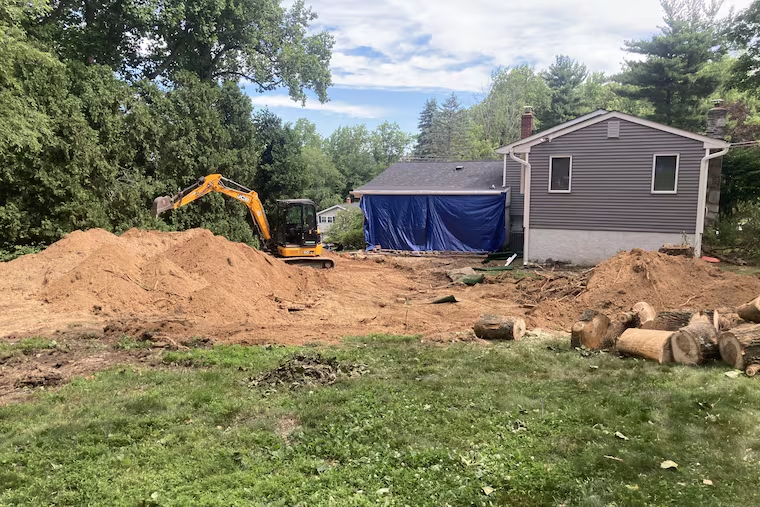
Homeowners across the Philadelphia region want to build garage apartments, in-law suites, and backyard cottages on their properties.
Read more 🩺 A win for nurses in Mount Holly | Inquirer South Jersey
Mario Mascioli, owner of Acorn Built Homes, said he gets hundreds of inquiries per month for these accessory dwelling units (ADUs), which have made up the bulk of Mascioli’s business since his company opened in late 2024.
“The demand is real,” said Mascioli, who works across southeastern Pennsylvania and in Princeton. And builders like him are ready to create ADUs. But municipalities’ varying and often restrictive land-use rules often make that difficult.
Pennsylvania lawmakers are currently considering legislation that would allow homeowners to create ADUs in places that are zoned for single-family houses without having to get special permission. The bill passed the state House earlier this month and is now before a state Senate committee.
Allowing for the construction of ADUs is part of Pennsylvania Gov. Josh Shapiro’s plan to increase the state’s housing supply and provide Pennsylvanians with more affordable housing options.
Mascioli has testified before state lawmakers to advocate for the loosening of restrictions for ADUs.
“It would mean that homeowners that want these — which are plenty of them — would be able to get it done quickly, more economically, favorably,“ he said. ”It would be fantastic.”
The Inquirer talked to Mascioli about the ADU landscape.
This interview has been edited for length and clarity.
Why do people want ADUs?
The three drivers for why people want them are: aging-in-place elderly parents; adult children that can’t afford rent or can’t afford to buy a home; and third, people want rental income.
What types of ADUs do you offer?
We build studios as small as 240 square feet. [But] most people want a space that has at least 500 square feet. Most opt for one or two bedrooms.
We [also] do additions. We do garage conversions. We do conversions of basements.
In many cases, we have to attach an ADU as an addition to a house because of the township requirements. And in many cases, we’re limited as to the features we can put into it, because of those requirements.
Read more House of the week: A six-bedroom Victorian twin in University City for $689,000
What’s something that clients have asked for that they weren’t able to get because of local land-use rules?
I’ll give you a real-time example. We start every project with what we call our “feasibility and scoping” phase. That takes about four or so weeks to dial in on what’s buildable from a structural, construction, architectural, and also an approvable perspective.
We have a customer we’re in the final phase of that study with. They have a beautiful property, plenty of land. They wanted a detached ADU for the couple’s mother, who’s going to be moving up from Florida to take care of their newborn, [who is due] in December. In this case, we can’t do a detached unit without going through a variance.
We also uncovered through our feasibility process that … if we were to extend the garage and build on top of it, that would require a variance.
Third thing is there’s a floodplain that runs through the property. And any modification to the footprint of the property would also be a variance.
Those are three separate variance processes, each of which would require attorneys and fees and zoning hearing boards.
So what we’re left building[without zoning approvals] is to raise up the loft on the second floor of the garage, put some dormers in it to make it more spacious, and create a one-bedroom living space there — butwithout a full kitchen with built-in cooking facilities. We can only put a kitchenette in.
That is very typical. That’s 90% of what we deal with as it relates to ADUs.
What’s different about building an ADU vs. a typical single-family home?
Basically, the red tape impedes or kills [ADU] projects before they start. And that is because there’s over 2,500 municipalities in Pennsylvania. Each with different zoning rules as it relates to ADUs.
In some townships, you can build one with no issues. But if you step, you know, a mile over the line in any direction, it’s either banned entirely or there are so many restrictions and other requirements that it takes [a] very long [time], if at all, to get through zoning hearing boards.
Permitting and the expense of the red tape can make many projects impractical.
Why did you decide to go into the ADU business in Pennsylvania with the challenges you’ve described?
If you look at things from a national perspective, 20 states have passed legislation like Pennsylvania currently has in its legislature.
People want them. That’s about affordable housing. I thought and still believe that it would be inevitable that ultimately Pennsylvania would pass such legislation. And if we were here in advance of that, establishing ourselves in the market, we would benefit from that legislation being passed.
Read more Who might threaten the Eagles’ NFC East three-peat? We assessed the state of the division.