
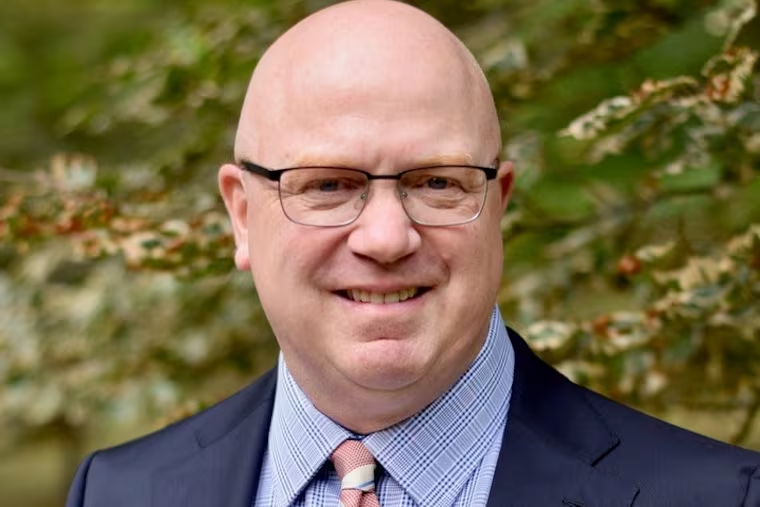
In one of the biggest outsourcing moves in Pennsylvania investment history, the board of the $84 billion-asset state teachers’ pension plan, PSERS, voted last week to outsource investments worth $20 billion to BNY Investments Mellon, replacing work now done by members of PSERS investment staff.
Read more 🪴 Back to basics | Morning Newsletter
“We are trying to be more efficient,” Benjamin Cotton, PSERS’s chief investment officer, said in an interview Thursday. PSERS staff “have done a good job” managing that money, he said, but commercial index fund fees have fallen so much, and Wall Street managers’ ability to match benchmark indexes has improved to where it’s best to hire outsiders.
At Wednesday’s meeting, Cotton told trustees that BNY, which is based in New York and has investment offices in Pittsburgh, is already a PSERS contractor and “wants to be an index fund manager for PSERS as well.”
He declined to estimate how much PSERS would pay the bank, adding that a final contract is under negotiation.
The resolution passed by the PSERS board calls on BNY to invest $16 billion in a “passive” (index-fund) portfolio of stocks “benchmarked to the S&P 1500.” BNY Mellon does not currently manage an S&P 1500 index fund, though the measure is used as a benchmark for BNY funds combining other indexes.
BNY documents show the bank charges institutional investors between 0.2% to 0.7% of assets per year for other index funds, which could result in PSERS payments to the bank of at least $32 million a year. But fund managers sometimes negotiate significantly lower rates with multibillion-dollar clients like PSERS.
PSERS also agreed to invest $4 billion with BNY in a foreign stocks fund, its performance to be measured against the Morgan Stanley Capital International (MSCI) World Ex-U.S. benchmark.
Cotton said no PSERS staffers would be laid off as a result of the outsourcing moves, with investors responsible for buying and selling stocks for the current portfolio reassigned to other work. He declined to estimate how many PSERS staffers managed the funds BNY will take over.
The board voted to approve the transfer, with only State Sen. Katie Muth (D., Chester) dissenting.
Read more They went to Mt. Airy ‘on a whim’ and found love to last decades
Muth has opposed or abstained from supporting scores of PSERS investments, citing the lack of fee information and other details she says are provided to the trustees.
The agency’s investment contracts often include fee formulas managers say are available to trustees like Muth on request but redacted from public viewing, though the annual sums paid to contractors have been published in separate reports without explanation of how the payments were calculated.
Manufactured housing profits
Also at Wednesday’s meeting, Cotton said PSERS would collect nearly $700 million from selling a major investment. People familiar with that investment confirmed it is a stake in Yes Communities, which has owned and developed hundreds of U.S. trailer parks with amenities such as swimming pools and clubhouses.
Cotton says PSERS invested a total of $230 million, starting in 2008, and including the new payout has received around $1 billion back, with another $500 million still invested in the same asset, currently through the Brookfield private investment group. Cotton said that return has been higher than if PSERS invested that money in the S&P 500.
That’s better than the results PSERS realized on some of its other “direct” real estate investments from that period, including a handful of Southern hotels and shopping malls, and vacant Harrisburg industrial properties.
The board also approved investments in TPG Peppertree Fund XI-A, an infrastructure fund, and PAI Mid-Market Fund II, a European private-equity fund.
The board did not consider two other investments recommended by staff, in a pair of private-credit funds.
Given poor results and variations in asset valuations reported by private-credit managers, Cotton said, PSERS needs to review its existing private-credit investments, and what’s happening to the high-risk loans that private-credit funds finance before buying more.
Read more Need a lawyer for your small business? These Penn clinics offer legal help for free | Expert opinion