
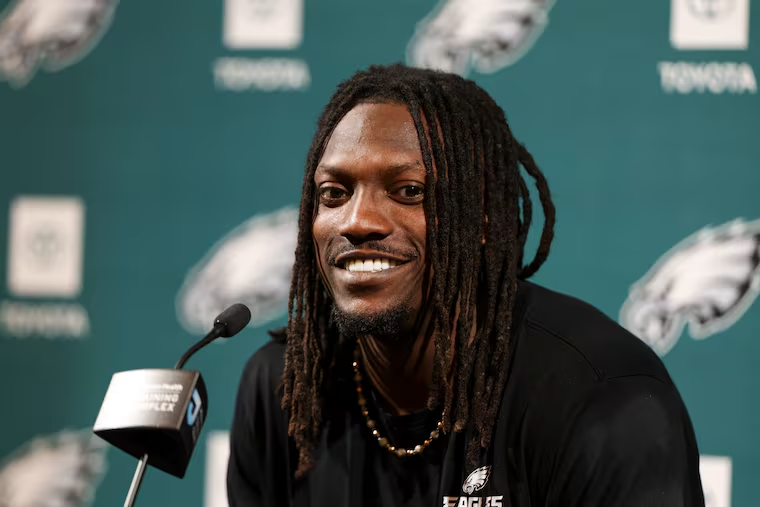
Much of the offseason focus for the Eagles was the impending trade of A.J. Brown and new offensive coordinator Sean Mannion taking the reins of the offense. During spring workouts, though, no player seemed to have more buzz than new defensive back Riq Woolen, who joined the Birds’ secondary after four seasons with the Seattle Seahawks.
The length, speed, and size combination of Woolen was enticing enough for Howie Roseman to spend $12 million on his services for one season in Philly. With Quinyon Mitchell and Cooper DeJean’s emergence in Vic Fangio’s secondary at corner and nickel, respectively, Woolen has an opportunity to flourish at a spot where the Eagles’ defense struggled last season.
Combining his film in Seattle with some eye-popping statistics, here’s why the Eagles are excited about Woolen — and how his acquisition helped set up DeJean for safety snaps in Fangio’s base defense.
Sticky coverage
It’s easy to forget that before becoming a fourth-round pick by the Seahawks in 2022, Woolen was a wide receiver by trade. The University of Texas-San Antonio product only spent his final two collegiate season at cornerback before entering the NFL.
The transition hasn’t always been seamless, though he splashed on the scene as a rookie with six interceptions. Grabby tendencies at the top of routes and biting on double moves were setbacks in his second and third seasons in the NFL, but what he did on the Super Bowl-winning Seahawks in 2025 was particularly special.
Woolen allowed just 2.7 yards per target in man coverage last year, the best mark among defensive backs with 20 or more targets, according to Next Gen Stats.
Even on plays new #Eagles DB Riq Woolen doesn’t get a great jam in man coverage or allows a free release, he has the speed to turn and run with most players in the NFL. His length also allows him to play through the catch point. Rep is never truly over for him even in a trail… pic.twitter.com/RyyU0ouEvs
— Devin Jackson (@RealD_Jackson) March 10, 2026
Even when his attempt to disrupt a receiver’s route timing misses, or he ends up in a trail position, Woolen has the closing speed and length to make up for it. His 33⅝-inch arms are in the 97th percentile among NFL defensive backs, and his 78⅝-inch wingspan is 89th percentile.
Woolen allowed 3.2 yards after the catch and his average target separation, which measures the average distance between the receiver and the nearest defender at pass arrival, was 2.2 yards, per Next Gen Stats. Both ranked among the best of qualified defensive backs.
For a cornerback his size, Woolen can transition quickly out of his backpedal or shuffle, which allows him to break on passes thrown in front of him. He is not always able to flip his hips fluidly against shiftier receivers, but his closing speed allows him to stifle pass catchers after the catch or recover fully before the ball is thrown.
Woolen’s length allows him to physically dislodge the ball out of the hands of receivers, especially on routes breaking across the middle of the field. He finished with 12 pass breakups in 2025.
First thing I noticed buzzing through coverage snaps from new #Eagles DB Riq Woolen is how disruptive he can be driving down on throws, whether it be stops, curls, out routes, and dig routes. Utilizing his length is a big part of his game, and he is really physical at the catch… pic.twitter.com/RxOPl0zlwa
— Devin Jackson (@RealD_Jackson) March 10, 2026
Erasing downfield passes was a big factor in Woolen’s strong final season in Seattle. The defense as a whole prevented offenses from generating explosive plays, and Woolen’s presence was a factor in that.
Across his career on deep passes, Woolen had an expected points added of plus-10.5 on deep passes, but that number lowered to plus-0.5 in 2025, according to TruMedia. He showed the ability to squeeze vertical routes toward the sideline, run stride-for-stride with receivers, and get his head around in coverage before the ball arrived.
Read more A last-second goal costs the USMNT a 3-2 loss to Turkey in its World Cup group finale
On nine targets of passes that traveled 20 or more air yards, Woolen allowed just two catches and had one interception as the nearest defender, per Next Gen Stats.
On passes that traveled 20+ air yards last season, Riq Woolen allowed just 2 catches on 9 attempts and had one interception. He does a nice job squeezing deep routes toward the sideline and staying in the hip pocket of receivers downfield. pic.twitter.com/3dbBROXhih
— Devin Jackson (@RealD_Jackson) June 25, 2026
Avoiding penalties should still be a priority for Woolen in coverage. He was charged with nine accepted penalties last year, which tied for sixth among NFL defensive backs. As teams will likely throw away from Mitchell’s side of the field in 2026, Woolen should expect to be tested early and often next season.
DeJean’s strong run support
If there’s an area of Woolen’s game that has been a glaring weakness, it’s his run support. He is an arm tackler and finished with 11 missed tackles across 16 regular season games in 2025, according to Pro Football Focus.
Meanwhile, as DeJean moves from corner to safety in Fangio’s base defense this season, one thing that won’t change is the All-Pro’s willingness to tackle in the run game. Even as offenses deployed heavier personnel (two or three tight ends) to take advantage of the Eagles’ light boxes on defense (six or fewer players between the tackles) DeJean’s presence at nickel still made the Eagles difficult to run on over the last two seasons.
On plays with at least five defensive backs on the field, which included DeJean at nickel since 2024, the Eagles had a defensive EPA on designed rushing attempts of plus-0.15 and a 62.4% defensive rushing success rate, according to TruMedia.
One area I think Cooper DeJean will benefit the #Eagles being at safety in their base defense is his run support. Even when he bounced between outside corner (in base) and nickel last season, he consistently made plays in the run game.
His ability fill downhill was especially… pic.twitter.com/GslX67VREU
— Devin Jackson (@RealD_Jackson) June 25, 2026
He will likely fill the role vacated by Reed Blankenship, who signed with the Houston Texans this offseason. Blankenship excelled at filling the alley from his safety spot in the Eagles’ secondary, and while the team is bullish on Drew Mukuba’s development heading into his second year, he’s not as consistent a tackler in space as DeJean, nor is he as physical.
DeJean’s move to safety in the base defense also allows the Eagles to have their best four defensive backs on the field at once and could signal less reliance from Fangio operating in his nickel defense on early downs. It also could open the door for more flexibility in personnel matching against teams that are looking for formational advantages.
DeJean and Woolen have shown the ability to defend different body types of pass catchers. In Seattle, Woolen would sometimes defend tight ends and slot receivers in addition to traditional outside receivers at outside corner. DeJean, playing outside corner and nickel last season, faced similar matchups.
Most of Riq Woolen’s snaps came at outside corner and I’d expect that to remain true with the #Eagles, but the #Seahawks lined him up at nickel 22 times last season, and seemed matchup dependent. Spent some time defending TEs (Kittle and McBride) and some hybrid/big slots like… pic.twitter.com/c8z6SVboCY
— Devin Jackson (@RealD_Jackson) March 10, 2026
Woolen, DeJean and Mitchell could prove to be one of the best trios in the NFL, and they’ll have challenging games to make their case, from facing the Cowboys twice to going up against the Rams’ core. There’s reason to be optimistic about an Eagles secondary that added a talented player in Woolen who could cash in big-time next offseason, whether it’s in Philly or elsewhere.
Read more Josh Shapiro says progressives’ wins in New York show voters ‘are channeling that pain into purpose’