
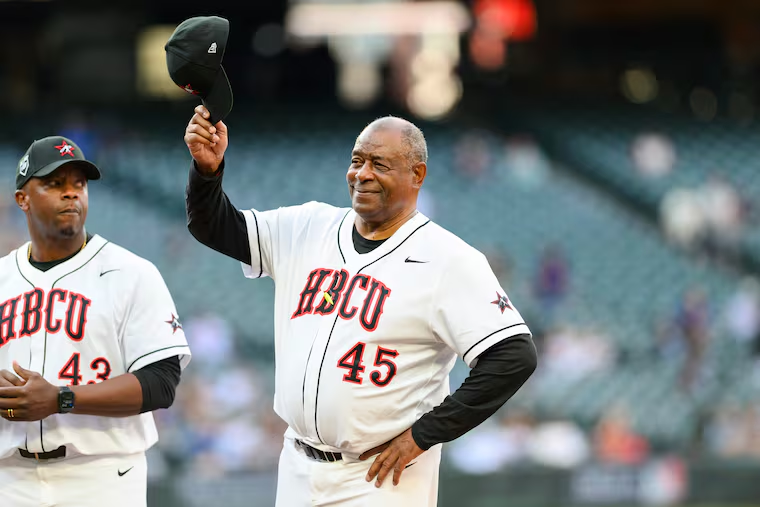
In honor of the nation’s 250th anniversary, Major League Baseball (MLB) is bringing the Mid-Summer Classic to the place where the Declaration of Independence was signed. Among the kick-off events is the HBCU Swingman Classic on July 10, an event showcasing the past and present of historically Black college and university (HBCU) baseball programs.
Read more One year of inspections at Jefferson Einstein Philadelphia Hospital: April 2025 — March 2026
The event, intended to increase interest in baseball among Black Americans, reflects MLB’s complicated relationship with Black fans. Across the 20th century, team owners and executives have tried periodically to draw Black fans to the ballpark. Yet, to maintain the game’s appeal to its traditional fanbase, much of it white, owners simultaneously created environments that did not fully welcome Black fans. This history shows that if MLB truly wants to draw more Black Americans to the game, it has to alter the culture of the game and do more than just stage one-off events like the Swingman Classic.
Until the 1940s, some Major League teams racially segregated their ballparks. As early as 1920, Black fans could sit only in the outfield seats at Sportsman’s Park in St. Louis, home to the National League’s Cardinals and the American League’s Browns. Following decades of advocacy by St. Louis’s Black community, the policy changed in 1944. Yet even after it ended, Black fans who still felt the sting of being segregated did not go to Sportsman’s Park in large numbers.
Even at ballparks where Black fans had not been formally segregated, MLB executives marginalized them by making it clear they did not believe Black fans deserved the same respect from players as white fans. For example, one Black fan recalled that as a child in the 1930s, “I was called a ‘black bastard’ by St. Louis Cardinal left-hander Clyde Shoun,” and in a demeaning move harking back to a common practice of slave owners, his “head was rubbed for good luck by St. Louis Cardinal right-hander Fiddler Bill McGee as he walked out of the clubhouse past the bleachers.”
Racism permeated the sport, inside and outside the ballpark. In a radio interview in 1938, despite not actually working in law enforcement, Yankees outfielder Jake Powell (who ended his career with the Phillies in 1945) claimed that he stayed in shape in the offseason by claiming to be a police officer who would beat Black people “over the head with my blackjack.” His comments provoked outrage and although Powell was suspended and forced to apologize, he remained with the Yankees through the 1940 season.
Yankees General Manager Ed Barrow told The Philadelphia Tribune, “No owner of a business permits his employees to be pert or insulting to the customers patronizing the business,” indicating that the team was happy to take money from Black fans but would prefer their players not share racist views on the air. Evidently, the team concluded that they should angle for revenue from Black fans—but keep Powell on the roster all the same.
As Jackie Robinson tore up the minor leagues in 1946, several MLB owners had another concern: too many Black fans if he were moved up to the majors. As they wrote in what was intended to be an internal document, they feared that “”
The next year, when Robinson broke MLB’s color barrier with the Brooklyn Dodgers, Black fans regularly made up as much as one-third of the crowd at his games. But as scholar Gerald Early recognized, it was “not the desire of any major-league baseball owner to have blacks make up the kind of attendance percentage they did when Robinson debuted in 1947. It would, indeed, be a cause of unease, if not downright unrest.”
Owners couldn’t stop Jackie Robinson and the waves of talented players of color who followed him to the majors. Instead, they made it more difficult for Black fans to attend games by building stadiums farther away from Black communities. Scholars Teams that moved between the 1950s and 1970s left neighborhoods that were on average 44.1 percent Black. By contrast, teams that did not move were in neighborhoods that were 17.6 percent Black. Almost all teams that relocated in this era moved to far whiter neighborhoods, including the Phillies who moved from Connie Mack Stadium in North Philadelphia to Veterans Stadium in South Philly after the 1970 season.
Read more Ryan Daly’s Philly basketball roots brought him to Syracuse — with a chance to revive the Orange
By contrast, in Houston, owners of a yet-to-be-named franchise secured vital Black voter support for the bonds needed to construct what would eventually be called the Astrodome. They promised that unlike many other public accommodations in Houston in 1961, it would be desegregated. But MLB owners continued to display bias against Black fans. Roy Hofheinz, who led the franchise and was the driving force behind the Astrodome, told a reporter, “We did a lot of research before choosing the colors [of the luxury suites]. We made sure the color complemented the complexion and clothing of women. It took us two weeks to get the right color of blue. Many blues would give ladies a pasty-looking complexion.” His concern reveals that he did not expect Black women to sit in the most exclusive part of the dome.
When the Baltimore Orioles opened Oriole Park at Camden Yards in Baltimore’s downtown in 1992, it seemed to signal a shift in ballparks’ relationship to urban spaces and their Black populations. Yet in other ways, the team continued MLB’s pattern of marginalizing potential Black fans. Maryland state representative Howard P. Rawlings noted that the Orioles had “neglected the city’s black majority” in the park’s opening festivities and argued “it’s a reflection of [the team’s] lack of awareness that” the city “is more than 60 percent African-American.” Ballparks evolved, but many MLB executives’ attitudes about potential Black baseball fans did not.
Even this year, new barriers to Black fan attendance were added, such as when the Texas Rangers installed the “One Riot, One Ranger” statue at their ballpark. The statue depicts a member of the original Texas Rangers, the state law enforcement organization the baseball team is named after, that was modeled on E. J. Banks, a ranger best known for being dispatched by the state’s governor to keep Black students from enrolling in an all-white public school in 1956. Banks stood by and watched as white segregationists threatened violence against any Black child who tried to enter the school.
Yet MLB is also making efforts to attract Black fans with events like the HBCU Swingman Classic at Citizens Bank Park. The Swingman Classic, named in honor of Black Hall of Famer Ken Griffey, Jr., is open to 50 current players from 17 historically Black Division I colleges and universities. The players will be divided into two teams, each coached by a Black former MLB player including, Phillies legend Jimmy Rollins.
Unlike the Home Run Derby and the All-Star Game being played a few days later at Citizens Bank, tickets for the Swingman Classic are comparatively affordable and cheaper than some Phillies games, an admirable and encouraging choice. History cautions, however, that MLB is usually only interested in extracting revenue from Black fans when doing so does not threaten the game’s largely white fan base. While the Swingman Classic will likely draw a higher percentage of Black fans to Citizens Bank Park than an average Phillies game, only time will tell whether it helps to shift MLB culture towards greater inclusion of Black fans.
Seth S. Tannenbaum is a Philadelphia native, historian, and associate professor of sport studies at Manhattanville University. His book, Bleacher Seats and Luxury Suites: Democracy and Division at the Twentieth-Century Ballpark was published this spring by the University of Illinois Press. He will be speaking at the Roxborough Branch of the Free Library of Philadelphia on Friday, July 17 at 3:30pm and at the Joseph E. Coleman Branch on Saturday, July 18 at noon.
Made by History takes readers beyond the headlines with articles written and edited by professional historians. Opinions expressed do not necessarily reflect the views of The Inquirer.
Read more Phillies make more bullpen moves by placing Tanner Banks on injured list, recalling Chase Shugart