
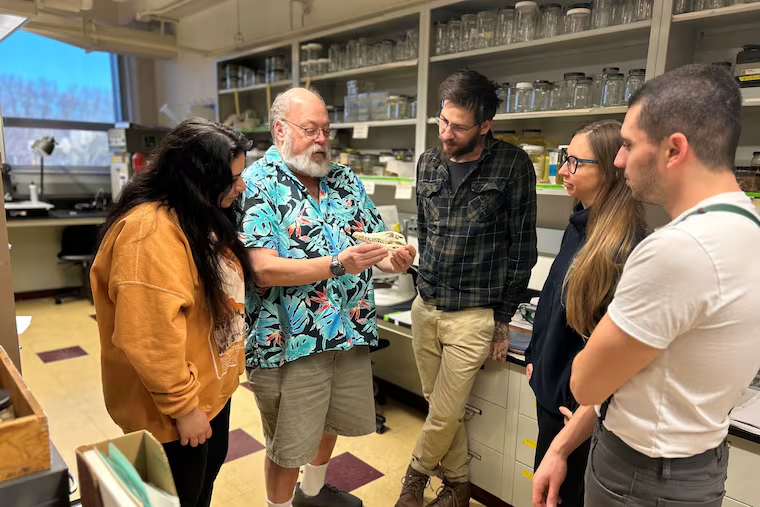
Scientist Aaron Bauer gawked at the cat-sized gecko.
The two-foot-long, preserved creature had sat unidentified in a natural-history museum in France for nearly two centuries.
Staring at its huge head and climber’s build, “I sure as heck could recognize that this was a gigantic, unknown species,” he said.
The extinct creature was the largest gecko to ever live, and the first new species Bauer — at the time a PhD student in his 20s — ever discovered and described.
Now a renowned herpetologist at Villanova University, Bauer, 65, has identified 320 new species of reptiles and counting — more than any other living scientist.
Scientists worldwide discover more than 16,000 new species every year, researchers estimate, spanning plants, animals, insects, and other forms of life.
Nicknamed “the Lizard King” by his students, Bauer retired in Mayfrom a 38-year-long teaching career at the university, where he mentored dozens of master’s students in herpetology, the study of reptiles and amphibians.
Some of his discoveries happened much like his first — seeing something in a museum that was “clearly something new,” he said. Others happened through regular travels to Africa, the South Pacific, and Asia.
His longest research project revolves around the original giant gecko he discovered 40 years ago during a 1980s trip to Marseille.
Bauer’s former graduate student, who later became a University of Michigan-Dearborn professor of biology, helped him analyze DNA from the gecko’s leg bone in 2023.
“If I have had a successful career, it’s because I’ve had great students who didn’t just come and go,” Bauer said.
The snazziest snake
Bauer spent his childhood exploring ponds, fields, and wildlife on the 68-acre Long Island estate where his grandfather was a caretaker.
He decided to become a herpetologist at age 5, after catching “the snazziest snake we have in the northeastern U.S.”
As an 8-year-old captivated by the bright green creature, Bauer typed up lists of all the Latin names of amphibians and reptiles.
He knew he wanted to work with these critters, but not how to make a living from it.
“Nobody in my family had gone to college, so what do I know?” Bauer said.
His path began with studying zoology and history at Michigan State University, where he graduated in 1982.
As aPhD student at the University of California, Berkeley, he specialized in lizards. It was the one species he could not find at the Long Island estate, where frogs, salamanders, turtles, and snakes abounded.
“Everybody wants what they don’t have,” he said.
Geckos, in particular, captivated him with their “weird features,” he said, including toe pads, the ability to climb, and lack of eyelids.
Read more High winds tear off roofs, partially collapse buildings across Philadelphia
His research explores the diversity of life and its history:
How does this lizard’s anatomy allow it to be successful? How is it related to the area of the world where it lives, and how did it get there?
In the field
At work, people know Bauer as the guy in Hawaiian shirts and shorts.
He tries not to wear such bright shirts in the field, because “you want to be a little more inconspicuous in the vegetation,” he said.
In these areas, the nearest human could be 50 or 100 miles away.
His team tries to sample from as many places as possible to capture diversity. Some days, they cover hundreds of miles. Other days, they spend a week in one place.
Usually, they identify a new species.
“One of the facts of field work is you don’t know what you’re going to find,” Bauer said.
His team brings nets for frogs, snake sticks for pinning venomous snakes, and equipment to collect tissue samples for DNA analysis. Lizards can be caught by hand.
From these field trips, he has collected enough material to work on for the rest of his life. Still, he said he feels a “physiological urge” to go back, and will continue researching as an emeritus professor.
Bauer always reminds his students how lucky they are to go to remote places like northern Namibia, where they may go a week without seeing another person.
“There’s something special about that,” Bauer said. “To go places that most people will never see and don’t know even exist.”
Raising an academic family tree
At this week’s national herpetology conference in New Orleans, a special session called “Bauer-fest” will celebrate hiscareer.
“He’s always continued to be a really strong advocate for all of his students,” said Daniel Paluh, an assistant professor at the University of Dayton in Ohio, and one of the former students organizing the event.
Paluh was intimidated by Bauer when he first met him at a conference, before realizing he was “a very friendly, funny, personable person.”
Bauer had an “open-door policy,” Paluh recalled, to help his students with research. That came with access to his personal library — one of the largest collections of books on herpetology in the world and the inspiration for a scene in the 2012 movie The Amazing Spider-Man.
Bauer alsocares about his students’ lives beyond graduation, said his Villanova colleague Todd Jackman, who is organizing a “Bauer-palooza” near the university in September.
About 80% of his former master’s students have stayed in the field, becoming professors in Louisiana and Kentucky, a museum curator in Australia, the head of nature conservancy in southern Angola, and more.
“I’m not crazy about being the center of attention, but I think that’s outweighed by the fact that I’ll have all of these people in one place,” Bauer said.
Read more Yardley’s Aiden Robbins and Moorestown’s Ryan Lynch selected in third round of MLB draft