
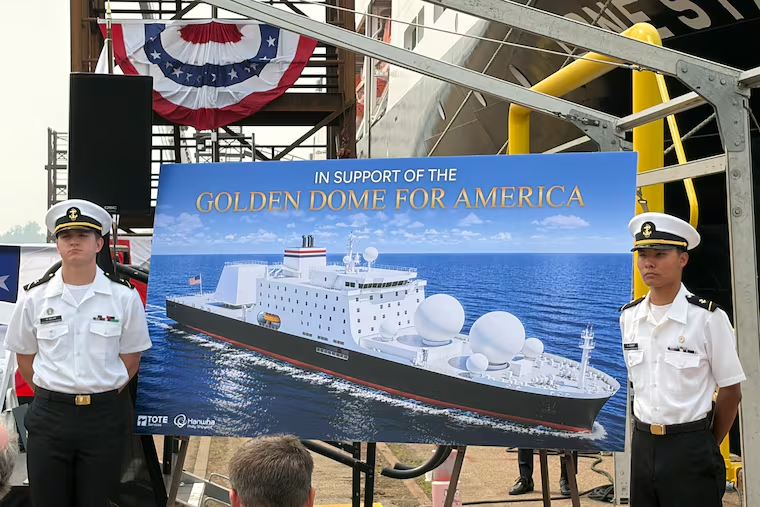
The federal government plans to build two new missile defense ships at Hanwha Philly Shipyard after it finishes the last of the “multi-mission” training and disaster-assistance ships it’s been building, Trump administration and shipbuilding officials said Friday.
Read more Penn State board awards president top performance bonus
But new Navy combat ships that yard leaders also hope to build in Philadelphia will have to wait until the yard has additional space ready, shipbuilding officials said.
The $1.4 billion contract to build two “Golden Defender” ships — officially Missile Range Instrumentation Ships, or tracking ships, topped by bulbous radar, antenna and other surveillance gear — was announced Friday by U.S. Office of Management and Budget director Russell Vought to hundreds of shipbuilders and government staff. The ships will replace surveillance ships built in the 1960s.
The group had assembled to watch Fox News host Rachel Campos-Duffy christen TS Lone Star, the fourth National Security Multi-Mission Vessel completed at the yard since 2023. The last of that line, TS Golden Bear, is due next year.
The anti-missile ships will be built on hulls the same size as the multi-mission ships, but without the multistory cabins used for cadets and hospital personnel, to make room for large-scale surveillance gear.
The new ships fit into a network of surveillance and combat gear developed by L3Harris and other big military contractors for the planned “Golden Dome” anti-missile network. They will keep the “hot production line” busy at the 2,000-worker shipyard for the next few years, U.S. Transportation Secretary Sean Duffy said.
Golden Dome will be built by Lockheed Martin, L3Harris and other defense contractors.
The new ships will be built under a management contract with Tote Services, a Jacksonville, Fla., company that has been overseeing construction of the multi-mission ships.
Tote and Hanwha have been delivering those ships “ahead of time and under budget,” Duffy said.
He contrasted Tote’s and Hanwha’s record, which built on previous yard owner Aker’s upgrades to the yard, with the slow pace of Navy shipbuilding in past decades. He said more ships should be built the Philadelphia way.
“Who controls the seas controls the world,” Duffy said, noting that the Trump administration supports reviving U.S. shipbuilding.
That effort will require vast public spending on design and procurement, plus recruiting and training hundreds of thousands of marine welders, crane operators and other ship construction workers.
Read more DraftKings sued Philadelphia for investigating whether it’s violating city consumer protection laws
“I’m a free enterprise guy, but we have to recognize that free enterprise doesn’t exist in shipbuilding because every [other nation is] subsidizing commercial vessels,” Duffy said.
Other new shipbuilding contracts are in the works for yards in Philadelphia and competing cities, he said.
“Big orders are coming our way. This is just the beginning,” Duffy said. “There is a lot of partisanship in Washington, but America stands together, Democrats and Republicans, as we figure out how we staff and build ships in our country.”
One of those “big orders” could bring more Navy ship construction to Philadelphia soon — if Hanwha can execute its long-planned expansion of the yard in time. The company has pledged an eventual $5 billion to help revive American shipbuilding but still operates the yard with a single 1,000-foot dry dock and one Goliath crane, a fraction of the size of its main Korean yard on Geoje Island.
On July 13, the Navy’s Portfolio Acquisition Executive for Maritime, the ship design, construction and maintenance agency formerly known as NAVSEA whose local offices are the largest employer in Philadelphia’s Navy Yard business district, awarded Tote Services a $2.2 billion contract to build up to eight Landing Ship Medium (LSM) vessels for the Marines.
Those ships will be built in three U.S. shipyards: Italian-owned Fincantieri’s Marinette, Wisconsin works; the family-owned Bollinger shipyard in Mississippi; and a third yard that has not yet been chosen, Jeff Dixon, president of Tote, said in an interview.
“The Marine Corps needed these landing ships in the Pacific two years ago,” Dixon said, stressing the military’s urgency to get the landing craft built. “Philly will compete in that process. I think they could fit them in,” and still continue work on its commercial ship construction contracts, if the yard can line up new berthing space.
Neighbor Rhoads Industries has two smaller drydocks and other space in and around the yard could be converted if Hanwha can arrange the space and the financing, he and other shipyard sources said.
JPMorgan Chase & Co. chief executive Jamie Dimon on a visit to the Navy Yard district said Tuesday that his bank has worked with Hanwha on other projects and is eager to back the company’s plans to expand construction of U.S. ships. Hanwha has expressed interest in building combat and support ships, submarines, and drones for the U.S, in Korea, Philadelphia and other potential locations.
Hanwha leaders have said U.S. military shipbuilding can be profitable and competitive with the leading shipbuilding nations — China, Korea and Japan — only if it scales up construction of commercial ships, making it much more efficient to build each ship.
The Philadelphia yard has been finishing a ship, on average, every eight months. Hanwha says it wants to build up to 20 ships a year in an expanded shipyard.
Read more Phoenixville native Tyler Nase is announced as head coach of Penn’s women’s rowing program