
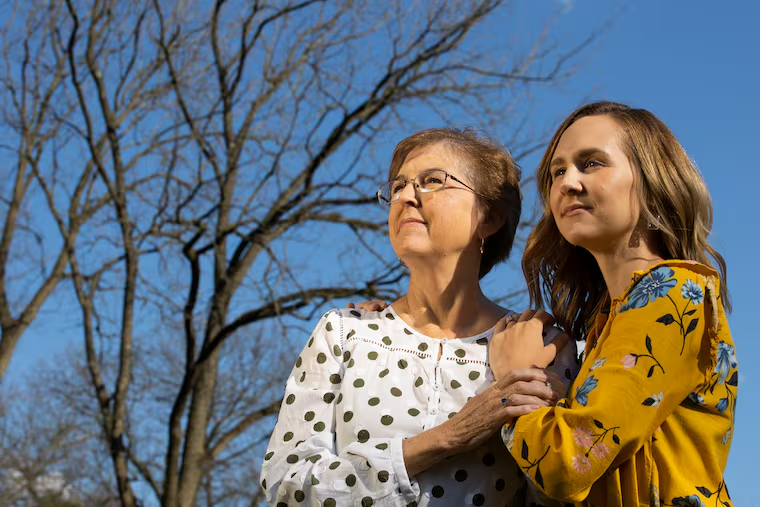
Lindsay Ward grows more nervous with each passing year, knowing her ultra-rare genetic disease could emerge at any time.
Read more How rogue officers turned a nationwide camera network into a tool for stalking
The 37-year-old schoolteacher from West Deptford, New Jersey, inherited the genetic mutation that causes RVCL — retinal vasculopathy with cerebral leukoencephalopathy — which damages small blood vessels throughout the body and typically shows up between the ages of 35 and 50. It causes premature death as brain, retinal, liver, and kidney damage accumulate.
Many patients die within five to 10 years of symptom onset.
“It’s relentless,” said Jonathan Miner, who directs the RVCL Research Center at Penn. “They go from being completely healthy to becoming blind, unable to walk or talk, with kidney failure and other problems.”
The disease currently has no cure. However, Miner recently received a $10 million gift from the Illinois-based nonprofit Clayco Foundation to develop a potential treatment.
The idea behind his small-molecule drug is to eliminate the faulty protein driving the disease before it can cause damage. The drug will still need to be tested in animals to evaluate safety before possibly moving into clinical trials.
Most exploratory scientific efforts do not advance to the point where they are found safe and effective in humans. Even if the results are promising, it could take years before a potential new drug becomes widely available.
Ward has already seen the disease ripple through her family.
Her uncle died from RVCL last year. Her mother, Barbara Small, was diagnosed in 2018 after almost four years of symptoms.
She hopes for a treatment that can help her avoid their fates.
“I do as many active things as humanly possible because I’m so worried about becoming frail,” Ward said. “I see the weakness that my mom has and I don’t want that.”
What is RVCL?
Fewer than 50 families worldwide are known to have RVCL.
The rare disease is often misdiagnosed as various autoimmune diseases, including multiple sclerosis and lupus. Only through a genetic test can patients verify an RVCL diagnosis — characterized by a mutation in a gene called TREX1.
The gene encodes a protein of the same name, TREX1, which, when mutated, becomes misplaced in a cell and damages DNA.
Over time, this causes small blood vessels to break down and disappear. The loss of blood flow leads to organ damage, including blindness, glaucoma, chronic kidney disease, strokes, and neurological effects.
When asked how he felt about the donation, Miner reflected on seeing many patients die from the disease and kids lose their parents young.
“I believe that everybody deserves a chance to live,” he said.
A potential drug
Miner’s drug candidate belongs to a new class of medicines called a degrader.
The drug eliminates the mutated TREX1 protein by pairing it with another protein called “E3.” E3’s role is to label other proteins for destruction, much like putting a shipping label on a package to direct it to the right address.
By labeling TREX1, “it basically tells the cell’s own machinery to eliminate this faulty protein,” Miner said.
If the drug proves effective, patients would ideally take it before they get sick, to prevent injury to blood vessels and organs.
When tested in mice with the disease, the drug protected cells from DNA damage and prevented premature death.
“We haven’t seen side effects in the mice, but we need to do much more extensive studies to prove that there are no side effects in animals before we can move forward,” Miner said.
The first and only FDA-approved degrader was developed for advanced breast cancer and approved in May. Miner’s TREX1 degrader is one of many variations on the novel technology that have emerged.
The $10 million donation will fund preclinical safety studies. The goal is to complete this testing over the next year, and, if it proves to be safe, move on to humans.
If the drug advances to a clinical trial, it would still take years to test the safety and efficacy. Most treatments evaluated in clinical trials do not become standard practice.
“Nothing has moved the needle yet in terms of delaying death and disability,” Miner said. “This, we think, gives us a real chance.”
Waiting
Ward’s 67-year-old mother, Barbara Small, who lives in Cape May Courthouse,started to show symptoms in her 50s.
What began as blurry vision and a damaged optic nerve progressed to a stroke. Roughly four years later, in 2018, she was diagnosed with RVCL.
Today, she is “pretty much blind” in one eye, Ward said, and has had a few strokes. She will frequently have aphasia, a communication disorder that can cause trouble speaking, and memory issues. Small is physically weak overall, and cannot walk very far without having to sit down.
“It is very challenging to see what your future will be,” said Ward, who helps take care of her mother.
Ward gets an MRI and diagnostic eye testing every six months to check for symptoms.
She and her husband, Matt, have three kids, with the youngest being a year and a half old. They don’t know whether their children inherited the mutation (testing is not recommended in children due to the late onset of the disease).
However, if a preventive treatment were to come out, she would test them sooner.
Ward recently attended the International RVCL Symposium at Penn, where Miner presented on his research and potential clinical trial.
For patients like her mother, the treatment would likely just stabilize her condition and not reverse existing damage, she said. However, Ward is hopeful that the drug, if proven to be safe and effective, could help prevent her and her kids (should they test positive for the mutation) from becoming symptomatic.
Read more Does the American masculinity crisis have roots in Valley Forge?
“I would like to live a long, healthy life,” she said. “That would be my goal.”