
The bodies of poor and Black Philadelphians have long been exploited in the name of medical progress — even after death.
Grave robbing was a common practice among medical schools like the University of Pennsylvania Medical School in the 18th and 19th centuries when the cholera outbreak created great demand for cadavers. Medical schools paid people to dig up and steal freshly buried corpses for medical students to conduct research in the hopes of developing cures.
Very often, a wealthy white population benefited from the cures experimented on these bodies.
Black Philadelphians were denied burials in the city cemeteries, many of these bodies would have been buried in the city’s potter’s fields without tombstones.
In 1794, after being denied worship at Old City’s St. George’s Methodist Church, the formerly enslaved Richard Allen, founded the Mother Bethel African Methodist Episcopal Church, considered the world’s first AME congregation. In 1810, he purchased what today is called the Bethel Burial Ground.
The minister who’d go on to become one of America’s most influential Black leaders, wanted Black Philadelphians to receive a dignified final resting place, with tombstones.
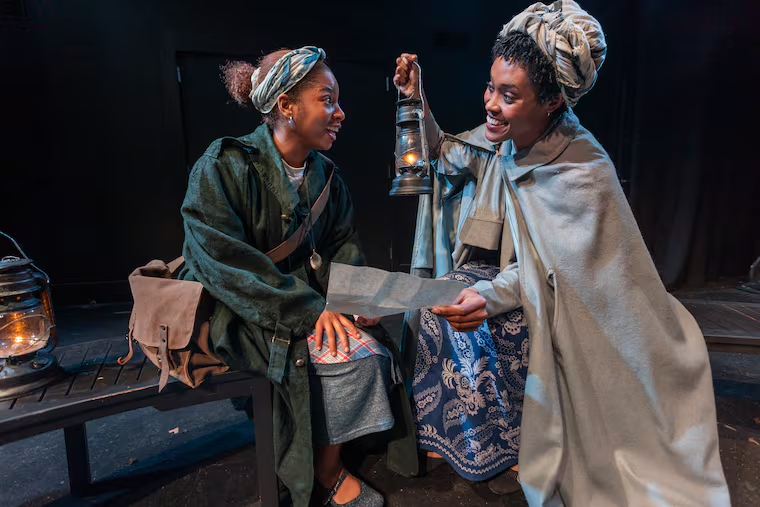
Through her 2024 play The Great Privation (How to Flip Ten Cents Into a Dollar), Harlem-raised playwright Nia Akilah Robinson seeks to offer audiences a peek into this macabre history that has Philadelphia roots.
“This topic of grave robbing is a subject in which I had conversations around the dinner table with my parents,” Robinson said. “It is a practice that has a long and storied history in Philadelphia, especially institutions like University of Pennsylvania medical school, and these crimes continue today.”
The play, set in Mother Bethel in 1832 and the present, is now being staged at Theater Exile.
It explores the history of grave robbing in America in the name of medical progress, through the story of a Black American mother and daughter who keep vigil over their recently buried loved ones’ graves to protect their bodies from grave robbers or “resurrectionists,” who were often white.
“I saw the description of a play, talking about an African Methodist Episcopal Church, 1832 graveyard in South Philadelphia,” Rev. Carolyn C. Cavaness of Mother Bethel said. “That’s Mother Bethel! That’s me.”
“We can never divorce ourselves from where we come from and our roots,” said Cavaness, who was appointed the church’s first female pastor in 2024.
The Bethel Church sold the graveyard in 1889 and the plot of land became a playground, today called Weccacoe Playground.
In 2014, amidst a remodel for the playground, historian Terry Buckalew raised concerns for the human remains underground. These concerns were proven true by a subsequent archaeological dig and remodeling plans were halted until a plan for a re-memorialization of the Weccacoe/Bethel Burial Ground could take place.
Robinson first drove past Weccacoe Playground and Bethel Burial Ground during rehearsals for Theatre Exile’s production. Philadelphia-based director Ontaria Kim Wilson wanted her to see for herself the place that she had been writing about all this time.
“When I was crossing into that block with Ontaria, as she was driving, I felt something, I can’t even explain it,” Robinson said.
“In Philly, there is a lot of respect paid towards talking about the history through those signs of what happened here. Sometimes when I go past those [historical markers ], I see a tribute, and I feel a sadness. I get why it’s there and I also [think] maybe we need more plays doing that, too.”
Today, members of the Mother Bethel congregation, families visiting Weccacoe park, and the thousands of Philadelphians and tourists walking past this small playground, hold the juxtaposition of young life and centuries-old resting souls at once.
Theatre Exile is partnering with Mother Bethel to offer the production crew a more real world context to the story of the play. Cavaness met with Wilson and attended the first rehearsal and will participate in post-show discussions during the run of the production.
“You always have the contesting and the non-acceptance of Black bodies being fully human,” Cavaness explained. “‘You’re not fully human, so I can do with your pieces, I can do with your body, as I see fit.’”
Cavaness can’t help but think of Allen, who was initially buried in front of Mother Bethel.
“They would have people guarding his body. Again, this notion of protecting the dignity and of having to reinforce that and to show that,” she said.
Organizations like the Mütter Museum and Penn Museum hold the remains of Black and Native Americans in their collections and in recent years have faced significant public backlash over the acquisition and display of those specimens. The Mütter has engaged in extensive community programming regarding its background as a medical history museum while receiving criticism that its efforts to repatriate the remains of indigenous people have moved too slowly. Penn has embarked on internment and repatriation processes that some critics and families argue have been flawed and rushed.
“We are the caretakers of this history. We are entrusted,” Cavaness said. “We have a responsibility to care for and uplift and to say their names and their stories. They just can’t go away.”
These real world, very local connections continue to inspire Wilson’s direction of the play in preparation for sharing it with the descendants of those buried in the Bethel Burial Ground. The Great Privation could rely on its inherent didacticism, but Wilson’s direction is focused on uplifting the love story of a mother and daughter, and Robinson’s surprisingly humorous writing.
Robinson hopes the play can be received as a comedy, even as it holds so much grief.
“I hope that [the audience] find themselves laughing. And I hope that Philly audiences feel like this play was written with care,” said Robinson.
“It’s Philadelphia. It’s the birthplace. It’s another chapter in who we are as a nation,” said Wilson. “And I think it’s important that, especially during this time, we grab onto any information that we can learn about this American experiment.”
“The Great Privation (How to Flip Ten Cents Into a Dollar)” runs through June 14, Theater Exile, 1340-48 S. 13th Street, theatreexile.org/tgp25
Read more A school’s fight over Black history | Morning Newsletter