
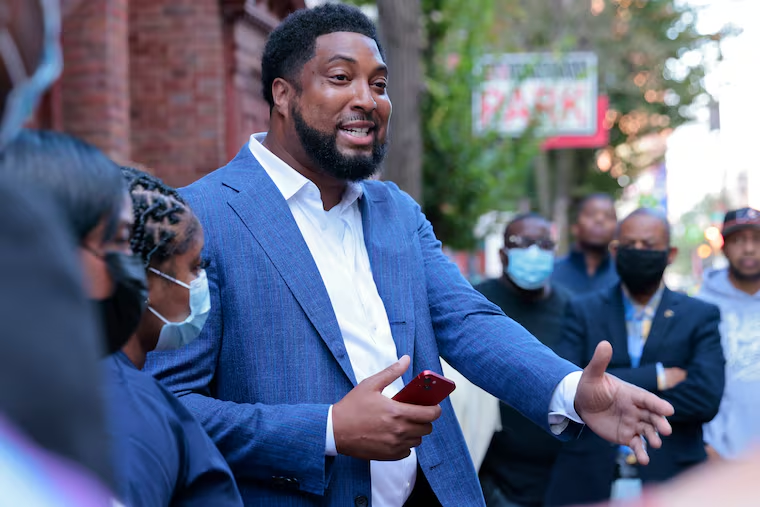
Christen “Chris” Woods, the former leader of one of Philadelphia’s largest labor unions was acquitted of theft and conspiracy charges Wednesday by a judge who rejected prosecutors’ allegations that he used a union-funded renovation project to secretly funnel money into local political campaigns.
Read more Can NASA really land astronauts on the moon by 2028?
In delivering her verdict, Common Pleas Court Judge Tracy Brandeis-Roman said prosecutors had failed to prove beyond a reasonable doubt that Woods — who once led District 1199C of the National Union of Hospital and Healthcare Employees — acted criminally when he hired longtime political operative Tracy Hardy to oversee the renovation of a bar inside the union’s Center City headquarters in 2019. The case against him, she said, relied on circumstantial evidence that did not definitively tie Woods to any wrongdoing.
As the judge declared Woods, 41, not guilty, he lowered his head toward the defense table, overcome with emotion. Behind him, family members and friends sprang to their feet, raising their hands toward the ceiling and shouting in celebration until Brandeis-Roman restored order by rapping her gavel.
The verdict brought to an end a protracted prosecution by the Pennsylvania Attorney General’s Office that accused Woods of orchestrating a plot to covertly channel money into Philadelphia’s 2019 Democratic primary elections.
Prosecutors alleged that Woods used a bar renovation project as a vehicle to steer more than $100,000 in union funds toward political consulting and campaign work benefiting candidates he supported, including one of Woods’ closest friends, Isaiah Thomas, who won a City Council seat.
Rather than rely on traditional campaign contributions, prosecutors said, Woods hired Hardy — who owned bars but did not work in construction — to develop fake and inflated estimates for the renovation project, then got one of those bloated proposals approved by the union’s board. Then, they said, Hardy took the excess money and used it to surreptitiously support the candidates.
Woods, who now owns a consulting firm and medical transportation business, was once viewed as a rising star in city political circles, and dozens of supporters sat in the courtroom to watch the case unfold. Thomas was among those who attended the proceedings, making a brief appearance during the trial’s opening phase in February. Brandeis-Roman conducted the non-jury trial over the course of months, before hearing closing arguments in May and issuing her verdict Wednesday.
During the trial, his attorneys blamed Hardy for any issues with the renovation’s cost or the accuracy of its invoices. Woods never intended to use the union’s funds for anything other than construction, they said, and if Hardy overbilled the union, he did so on his own — and to line his own pockets.
Hardy pleaded guilty in federal court last year to charges stemming from the bar renovation, as well as a separate scheme in which he fraudulently obtained $2 million in pandemic relief funds.
He is scheduled to be sentenced in September.
“This isn’t a case about theft from a union,” Woods’ attorney, Keir Bradford-Grey, said in court. “This case is about a fraud between Hardy and [his contractors].”
Among the evidence presented were financial records and witness testimony that prosecutor James Price said showed the renovation project’s cost ballooned from an initial estimate of about $47,000 to nearly $150,000 by the time the board approved it. Price said that was because Woods and Hardy were secretly using the arrangement to fund political consulting by Hardy for candidates of Woods’ choosing.
Read more An artisan brewery is opening its second outpost | Inquirer Chester County
“You cannot spend union money just because you think it’s for the best,” he said in his closing argument.
But Woods’ attorneys said the initial estimate for the construction project was unrealistically low, and that Hardy did ultimately renovate the bar.
If Hardy was a sloppy bookkeeper or dubious project manager, they argued, that did not make Woods guilty of knowingly misdirecting his union members’ funds to another purpose.
Woods’ trial also included testimony by Ryan Boyer, head of the politically influential Philadelphia Building and Construction Trades Council and one of the city’s most powerful political figures. Boyer spent half a day on the witness stand answering questions about his relationship with Woods and Hardy, as well as his assessment of the bar renovation’s costs.
Although Boyer served as a prosecutors’ witness, he delivered testimony that appeared to bolster Woods’ case: He said Hardy was a shady operator who cut corners and spread himself too thin, and suggested that any issues with the bar renovation likely stemmed from Hardy’s conduct.
On Wednesday, Brandeis-Roman said the evidence left room for competing interpretations, with facts that felt as if they “could go both ways.” Combined with testimony from 19 character witnesses who vouched for Woods’ integrity, she said, the uncertainty convinced her that prosecutors had not met their burden of proof.
“Sometimes,” she added, “all you have is your good name, and that should mean something.”
Among those in the courtroom was Woods’ mother, Valencia, who jumped from her seat after the verdict and repeatedly shouted, “Thank you Jesus. Thank you God,” until she embraced her son in the hallway outside of the courtroom.
There, surrounded by loved ones, Woods said the verdict meant “I’m finally able to move on with my life.”
Bradford-Grey added: “I am glad people will finally get to see he is not the person he was portrayed originally in the paper. It’s time to put this to bed and let Chris be the man we know he is.”