
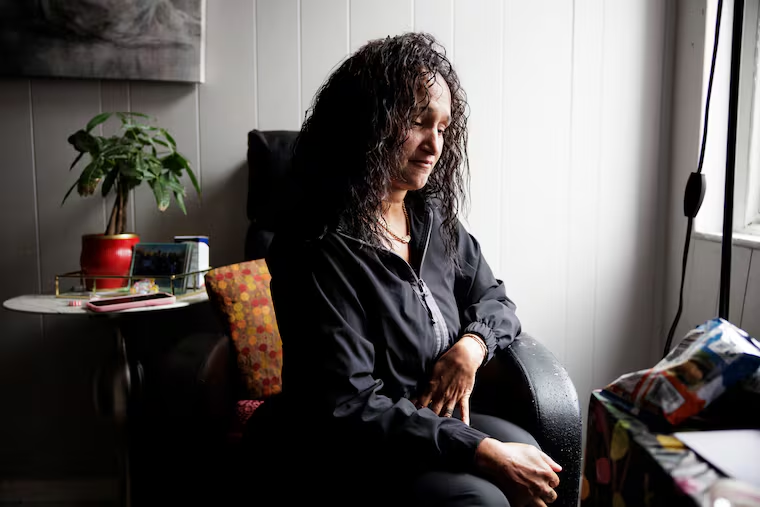
It was early on a Friday evening, a week after her 9th birthday. Ashley Rivera, already in her pajamas, walked from her home across the street to the 7-Eleven to grab a snack. She was within eyesight of her stepdad, who sat on the front porch of their Kensington home, smoking Newports, crutches at his side.
Read more Australian wine gets a bad rap, but it’s not all Yellow Tail
Rivera left the convenience store and noticed a man in his 60s in a green Jeep. He had long, greasy, stringy hair, and had been slowly circling the block.
At first, she didn’t pay him much attention. She lived in Kensington, where throngs of people suffering from addiction crowd the sidewalks, and sex workers linger under the El tracks. She figured he was just another guy looking to pay for drugs or a woman.
But he had his eyes on her.
The man pulled up, rolled down his window and asked her to get into his car. He called her sexy.
Rivera moved away. But the man jumped out and gripped her arm tightly. She screamed for help as he dragged her toward his Jeep.
Even now, 17 years later, she remembers his eyes. “He looked very evil,” she said.
Rivera, who is 26, was stunned to learn this week that the man who tried to abduct her was Raymond “R.C.” Horsch, the shock-seeking pornographer now linked to at least seven missing women.
Horsch’s Olney home, and his bizarre past, have been at the center of a sprawling local and federal investigation since June that has uncovered a trove of disturbing digital evidence suggesting he may have killed women he lured off the streets of Kensington.
He died in 2025 at the age of 82. His son Eugene, with whom he shared the Olney twin, is in prison on federal charges from a June 19 car stop near Independence Hall, in which authorities recovered the fake ID of a missing woman. Eugene has not been accused of any violent crimes involving the deaths or disappearances of the women.
Rivera’s account is the first known instance of Raymond Horsch attempting to victimize a child, and shows his violent obsessions may have extended beyond the women in addiction he exploited for decades. It also offers new insight into how Horsch evaded consequences.
“I really do feel like I escaped something big,” Rivera said. “He could have kidnapped me. He could have done the same thing to me that he did to those women. He could have raped me, killed me.
“I was a 9-year-old girl. I was just a kid.”
An unforgettable face
Rivera credits her stepfather for helping her escape Horsch’s grip that evening in March 2009.
When he heard her scream, she said he hobbled off the front porch and hit the back window of Horsch’s Jeep with one of his crutches. Horsch sped off.
Rivera ran inside, crying to her mother, Sasha, who called 9-1-1.
Sasha, in an interview this week, said she then ran outside and saw Horsch circling their block.
“I chased him with a baseball bat,” she said, swinging it at the Jeep as he drove by. “I thought he was going to kill her. If he had taken her, I may never have found my daughter.”
Police arrived to find Horsch near the 3200 block of Kensington Avenue, according to an arrest report. Inside his Jeep, officers found a pair of high-powered binoculars, a digital camera, telephoto lens, an eye patch, and a condom.
Officers asked Rivera and her mother if this was the man who had tried to lure her into his car.
There was no question it was him.
“I couldn’t forget that face,” Ashley said.
‘I just broke down crying’
Police arrested Horsch and he was charged with luring a child into a motor vehicle and corrupting the morals of a minor.
Several months later, in January 2010, Rivera appeared in a courtroom in the decaying former Family Court building on Vine Street to testify against Horsch.
Rivera shook as she walked to the stand to testify. Horsch and his lawyers sat just a few feet away. She said he glared at her, with one eye looking straight ahead; the other bulging out crookedly.
“I was so scared, and he just kept staring at me. I just broke down crying,” she said. “I felt like I was looking at a killer.”
Rivera said her testimony had to be cut short.
“They made me get off the stand because I was crying so much,” she said.
The prosecutor on the case, Jill Fertel, said Rivera had to to sit through Horsch’s attorneys accusing her of lying and saying she wasn’t as innocent as she appeared because she grew up in a rough neighborhood.
“They said the morals of a girl from Kensington were harder to corrupt than a girl from Chestnut Hill,” Fertel said, referring to a wealthier neighborhood near the city limits.
The memory she can’t escape
Common Pleas Court Judge Roger Gordon convicted Horsch of both counts and sentenced him to 2½ to 5 years in prison.
The conviction meant Horsch would have been required to register as a sex offender under Megan’s Law, but he requested a “trial de novo,” or a new trial, in Common Pleas Court.
Unlike a typical appeal — where a higher court reads the transcript of the lower court to check for any legal or procedural errors — a trial de novo wipes the slate clean.
Rivera would have to testify again.
When Rivera learned this, she begged her mother to not make her go back to court. Sasha Rivera, who is 46, said she couldn’t put her daughter through such trauma again.
“I thought he and his family would do something to us,” Sasha Rivera said of Horsch.
A new prosecutor took over the case. But without Rivera, the District Attorney’s Office dropped the charges against Horsch. The original conviction was vacated.
Fertel said Rivera’s experience was “horrible.”
“The system was not designed for children,” she said. “There is a difference between being able to confront your accuser and being able to intimidate a victim.”
The state upgraded the crime of luring a child under the age of 13 to a felony in 2013. Fertel also said courts now more frequently allow children to testify on camera from another room to avoid their abuser.
In 2015, Horsch successfully petitioned for the case to be expunged.
Records from the case, including a psychological examination of Horsch, are at risk of being destroyed. The Inquirer has filed a motion with the court to preserve them and make them public, and a judge ruled Thursday that they shouldn’t be immediately destroyed.

Read more of The Inquirer’s reporting on the sprawling missing persons investigation centered around the late pornographer Raymond “R.C.” Horsch and his son, Eugene:
- How a pornographer’s violent art complicates Philly missing women mystery
-
Raymond Horsch had access to a Kensington crematorium linked to illegal body parts sales, years before investigation
-
‘Consumed by anger’: Inside the 1985 psych profile of Raymond Horsch
- A troubling photo of a missing woman appeared on Raymond Horsch’s erotic website, years before police investigated
- Police grapple with a lack of bodies in disturbing Olney investigation — and for families, a lack of closure
- Two women appear dead in “graphic and dark” videos recovered from Olney house, police say
Ashley Rivera, who said she supports unsealing the records, said the incident with Horsch left her scared to play outside as a child. Even today, she said she struggles with anxiety.
“When men stare at me, I’m instantly scared,” she said.
It has also affected the way she raises her son, who is the same age she was when Horsch grabbed her. She said she’s afraid to let him go anywhere alone.
“We have a park down the block from my house, literally on the corner of my block,” she said. “He asks me, ‘Hey mom, can I go to the park by myself?’”
She tells him no. She’ll go with him. “And then he doesn’t want to go because he doesn’t want to go with his mom because all the other kids are by themselves.”
“I tried to get that memory out of my head,” she said. “But I can’t. It stays with me.”
Rivera now works as a receptionist in Northeast Philadelphia. She never realized Horsch walked free after she didn’t appear at his second trial. She said she feels guilt because had she been able to testify again as a child, perhaps the case wouldn’t have fallen apart.
“Maybe it’s my fault that he was free,” she said. “I thank God every day my stepdad was there to save me because I could be missing or dead. I feel really lucky.
“But I feel so bad for all the victims and their families. I didn’t have to go through what they went through.”
The Inquirer’s journalism is supported, in part, by the Lenfest Institute for Journalism and readers like you. News and editorial content are created independently of The Inquirer’s donors. Gifts to support The Inquirer’s high-impact journalism can be made at inquirer.com/donate. A list of Lenfest Institute donors can be found at lenfestinstitute.org/supporters.
Read more Redeemer Health CEO Greg Wozniak has resigned from the Montgomery County health system