
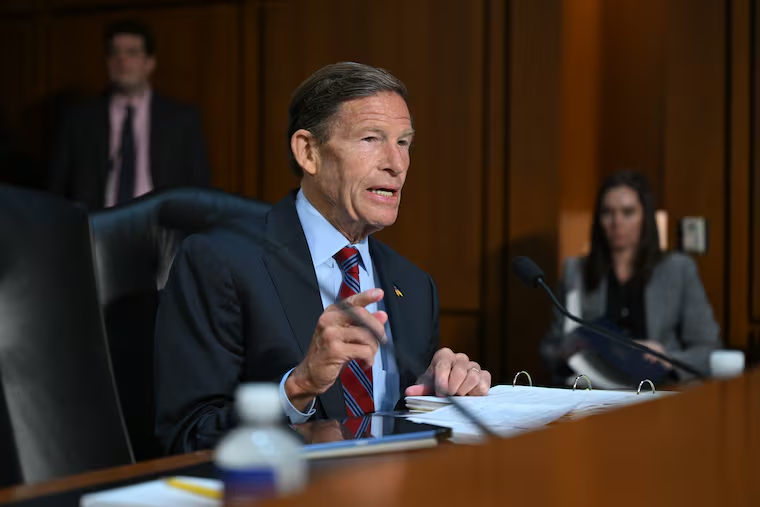
Three members of Congress have renewed their criticism of FanDuel Sportsbook, accusing the company’s leaders today of providing “misleading and incomplete” responses to a recent inquiry about the VIP services and rewards that it offers to customers.
Read more New owner for bankrupt Swarthmore Group plans shift to venture capital
In a letter to FanDuel chief executive officer Christian Genetski, U.S. Sen. Richard Blumenthal (D., Conn.) and U.S. Reps. Paul D. Tonko (D., N.Y.) and Valerie P. Foushee (D., N.C.) wrote that they “remain unconvinced that FanDuel is making an active effort to protect bettors from harmful gambling and instead appears to be promoting addiction.”
The lawmakers had initially sent letters on Aug. 10 to FanDuel, Major League Baseball, and the Major League Baseball Players Association, and demanded that each make policy changes following an Inquirer story about a personal video greeting from Phillies star Bryce Harper that a FanDuel VIP manager sent in 2024 to a bettor who had a gambling addiction.
In response, the MLBPA said last week it would support banning players from doing promotional work for sportsbook VIP programs in the union’s next collective bargaining agreement.
The lawmakers had called on FanDuel to eliminate its VIP rewards and disclose information about those services, including whether the company had sent videos of other athletes to VIP bettors, or offered promotions to gamblers who experienced losing streaks and attempted to cut back on wagering.
In an Aug. 14 response, FanDuel wrote that it is “committed to being a transparent and cooperative partner” but did not directly respond to many of the lawmakers’ questions.
The company said it spent $158 million on responsible gaming in 2025, and that it extensively reviews customers’ betting history before offering them VIP status.
“Sports wagering is one of the most heavily regulated industries in the United States,” wrote Cory Fox, a FanDuel senior vice president, “and FanDuel operates a licensed online sportsbook in 26 U.S. jurisdictions.”
The lawmakers seized on this point, writing that FanDuel also has a prediction market, FanDuel Predicts, “which undermines the integrity of — if not bypasses — those very regulations.”
A FanDuel spokesperson said Thursday morning that he was reviewing the letter.
Prediction markets allow customers to wager on a range of subjects: sports, politics, Hollywood award shows, the weather. They’re regulated by the federal Commodity Futures Trading Commission, which thus far has enforced few limitations on companies like Kalshi and Polymarket.
Critics — including former New Jersey Gov. Chris Christie, who works as a strategic adviser to the American Gaming Association — contend that prediction markets are running illegal sports betting operations. New Jersey Attorney General Jennifer Davenport earlier this week petitioned the U.S. Supreme Court to decide whether states should have the authority to regulate the markets.

The Inquirer is investigating how the rise of the multi-billion dollar sports gambling and prediction market industries are affecting public health and professional sports. Read more of our coverage:
· FanDuel sent a personal message from Phillies star Bryce Harper to a VIP customer with a gambling addiction
· Bryce Harper addresses controversy over his video to FanDuel VIP bettor
· Congress demands FanDuel, MLB and players union make policy changes, citing Harper controversy
· MLBPA supports banning players from promoting sportsbook VIP programs
· As the betting industry grows, kids as young as 11 are getting hooked
· Lawsuit accuses FanDuel, DraftKings, and the NFL of profiting from ‘unreasonably dangerous’ microbetting
· He wrote the book on sports gambling’s rise. Here’s what he thinks you should know.
In their latest message to FanDuel, the lawmakers described the company’s “VIP perks, constant push notifications, and personalized promotions” as exploitative, and demanded the company provide a written response to eight questions by Sept. 17.
Sportsbook VIP rewards and push notifications are a central thread in a lawsuit that the nonprofit Public Health Advocacy Institute filed in March in Common Pleas Court of Philadelphia against FanDuel, DraftKings, the NFL, and the data company Genius Sports on behalf Montgomery County resident Terry Thompson, and Delaware County resident Christopher Sage, VIP bettors who each developed ruinous gambling addictions.
FanDuel, DraftKings, the NFL and Genius Sports have each sought to have the case dismissed.
Thompson, who received the 21-second video of Harper, lost more than $1.8 million on sports bets, and planned to die by suicide earlier this year, rather than reveal to his family the scope of his losses.
Harper has said that he recorded the message through the video service Cameo, but didn’t know that Thompson had addiction, nor that FanDuel intended to use it as a VIP reward.
This is a developing story and will be updated.
The Inquirer will continue to report on issues related to the growth of gambling addiction — among teens and adults — across Pennsylvania. If you, or someone you know, wants to speak with a reporter, please contact David Gambacorta or William Bender at [email protected] and [email protected]
The Inquirer’s journalism is supported, in part, by the Lenfest Institute for Journalism and readers like you. News and editorial content are created independently of The Inquirer’s donors. Gifts to support The Inquirer’s high-impact journalism can be made at inquirer.com/donate. A list of Lenfest Institute donors can be found at lenfestinstitute.org/supporters.
Read more 2026 Volkswagen Tiguan turbo: Well, here’s a surprise