
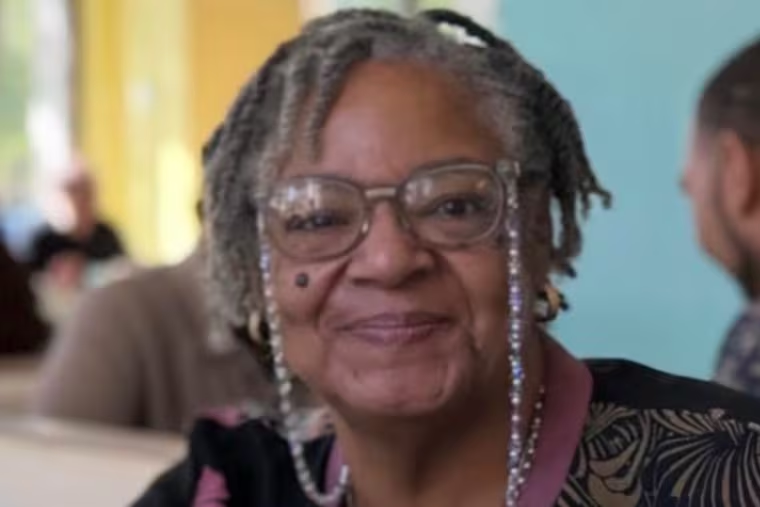
Maida Odom is believed to be the second Black woman to work as a reporter for The Inquirer. She joined the staff in 1978 and, by all accounts, was a trailblazing firecracker of a journalist.
Read more Here are some of the questions Chester County voters will be asked in next week’s election
Former Inquirer colleagues called her “tough” and “intimidating,” and she covered all sorts of stories until she left the paper in 2000 to pursue other opportunities. She reported on school desegregation in Wilmington in 1978, on a spectacular armored truck heist in Philadelphia in 1981, and on a visit from South African politician and social activist Winnie Mandela in 1997.
She also wrote stories about AIDS, the NAACP, the Nation of Islam, the death of former U.S. Rep. Barbara Jordan, how local businesses employed ex-offenders, and dozens of other topics.
Most notably, in May 1985, Professor Odom spent 20 hours secretly reporting from a nearby house during the two-day confrontation between police and members of the MOVE group on Osage Avenue in West Philadelphia. She and a colleague were eventually discovered by police and escorted from the house shortly before police dropped a bomb on the MOVE house, and 61 homes in West Philadelphia were destroyed.
For the next year, Professor Odom was a key member of The Inquirer’s reporting team on MOVE that was a finalist for the 1986 Pulitzer Prize for general news coverage. “She was an exacting journalist,” former Inquirer colleague Annette John-Hall said. “She knew how to get past the first layer of a story and get under the second layer.”
In The Inquirer on Dec. 6, 1985, Professor Odom wrote: “There were no flowers, no hymns, no sorrowful tears. MOVE co-founder John Africa and his nephew, Frank James Africa, were laid to rest in Whitemarsh Memorial Park in eastern Montgomery County yesterday with bitter tears and angry words.”
On Saturday, Oct. 24, Professor Odom died of complications from metastatic breast cancer at Pennsylvania Hospital. She was 73.
“She was a genuine person,” Sandra Long Weaver, former vice president of newsroom operations for The Inquirer and Daily News, said. “She was interested in promoting people of color and seeing people succeed.”
Arlene Notoro Morgan, former assistant managing editor at The Inquirer, said: “She certainly was fearless in covering the streets.”
After leaving The Inquirer, Professor Odom spent 13 years, from 2005 to her retirement in 2019, as an assistant professor in the Department of Journalism at Temple University. She was also a playwright, a documentary filmmaker, and, according to David Boardman, dean of Temple’s Klein College of Media and Communication, “a champion of diversity and opportunity.”
“Maida … was a passionate advocate for the integrity of journalism,” Boardman said in a tribute, “in both the newsroom and the classroom.”
At Temple, Professor Odom connected with students and forged relationships between the university and local high schools and other organizations. She taught public affairs reporting and elements of writing, was director of internships, and created Temple’s high school journalism workshops.
“It’s part of an overarching notion of community-based education where a lot of your learning doesn’t take place in the classroom,” she told the Temple News in 2014 about the high school workshops. “And I think that’s very important, particularly for journalists.”
In 2025, Professor Odom was featured in a six-part podcast called MOVE: Untangling the Tragedy that was produced by Temple and The Inquirer. She also wrote a play, MOVE Mocks Us All, about the bombing and told The Inquirer in 2025: “What I learned most from all of this is when you sow seeds of hatred, you can’t control how they grow.”
She coproduced 1199 at 25: The Power of Collective Action, a 2002 documentary about the labor struggles of the National Union of Hospital and Health Care Employees in Philadelphia. She mentored young people wherever she worked and was active with the Philadelphia chapter of the National Association of Black Journalists.
Before The Inquirer, Professor Odom covered Jimmy Carter and the 1976 presidential election for the Dayton Daily News in Ohio. Before that, Professor Odom wrote about community news for the Akron Beacon Journal. She followed Charyn Sutton, the first Black woman reporter at The Inquirer, and also worked in public relations and as a newsletter editor, and was on the board at Scribe Video Center.
Friends and colleagues called her an “extraordinary woman,” “a delightful person,” a “great journalist,” and “an exceptional teacher” in Facebook tributes. One colleague said on Instagram: “She was a no nonsense truth teller, a brave, fearless journalist who refused to look away.”
Her brother, Vernon, said: “She was intense.” Longtime Inquirer colleague Roy H. Campbell said: “She had a low tolerance for BS.”
Maida Cassandra Odom was born Dec. 12, 1952, in Louisville, Ky. She grew up in Akron, Ohio, and was a talented writer and straight-A high school student.
She was inspired to engage in social activism and academia by her parents, and she earned a bachelor’s degree in journalism at Northwestern University in Illinois. Later, she did extensive graduate work in Africana studies and other topics at the University of Pennsylvania.
Professor Odom enjoyed reading and traveling, especially to the beach in Jamaica. She was a member of Alpha Kappa Alpha Sorority Inc. and taught Sunday School and was on the board of trustees at St. Matthew AME Church.
“Maida’s reach was far,” her brother said. “Maida’s reach was wide.”
In addition to her brother, Professor Odom is survived by other relatives.
Services are to be at 11 a.m. Wednesday, Nov. 11, at St. Matthew AME Church, 215 N. 57th St., Philadelphia, Pa. 19139.
Donations in her name may be made to the Philadelphia chapter of the National Association of Black Journalists, 1939 Fairmount Ave., Suite 56040, Philadelphia, Pa. 19130.
Read more Flyers mailbag: What’s next for Oliver Bonk, and is Danny Brière poised to make a big trade?