
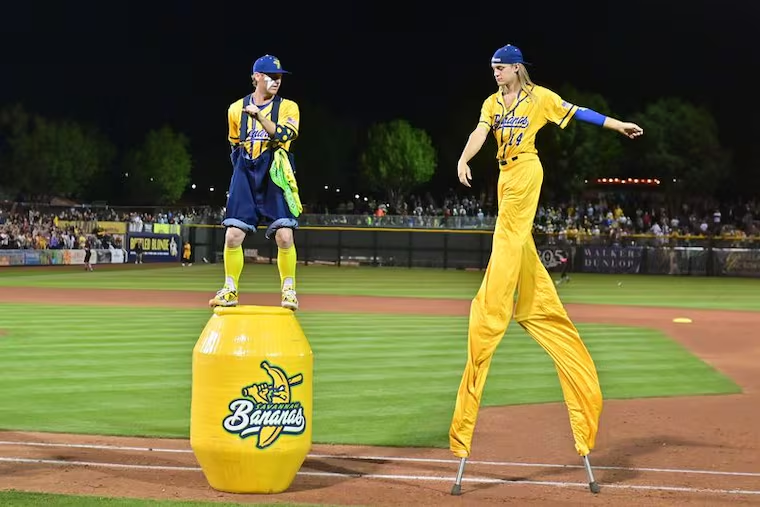
One of the more striking sports stories of the last few years has been the dramatic rise in popularity of the Savannah Bananas. Founded as a collegiate summer league team in 2016, the Bananas began playing exhibition games in 2018, when they debuted their signature “Banana Ball,” a fast-paced, acrobatic, comedic, participatory style of baseball. Since 2023 they have dedicated themselves entirely to traveling exhibition games against other “Banana Ball” teams, and their popularity has continued to grow. On May 2, as part of the ongoing , they played before their largest audience yet, a crowd of 102,000 at Kyle Field in College Station, Texas.
The Bananas and Banana Ball represent a compelling innovation in baseball and American sports—but at the same time, they’re building on one of the sport’s oldest and most enduring traditions: barnstorming, alternatives to professional and major leagues that have long brought community and inclusivity to baseball and America.
Most histories of baseball focus on its professional leagues: the U.S. Major Leagues and sometimes other prominent professional organizations such as the Negro Leagues and Japan’s Nippon Professional Baseball. But starting in the mid-19th century, there was an equally popular alternative version of baseball that existed outside of those more established sites. Known as barnstorming, probably because many of its games took place in rural communities that might well have featured farm structures, the reference that also connected these baseball teams to other traveling performers who also used the term. This version of baseball saw touring collections of players—sometimes part of an established team, but just as often cobbled together from across multiple teams—visit communities and stage exhibition games. These games were played against local teams and players, fellow barnstorming teams, or as part of other unique entertainments.
In the first half of the 20th century barnstorming came to be especially associated with the Negro Leagues and represented a way both for those Black athletes to showcase their talents in front of more diverse and widespread audiences. It also allowed them to play against—and, even at times, alongside—white athletes during a time in which the Major Leagues excluded Black players. Building on the legacy of late 19th century, Black barnstorming teams like Bud Fowler’s All-American Black Tourists, legendary 20th-century players like the great Satchel Paige organized teams that toured constantly and brought baseball to every corner of the nation. It also inspired one of the great sports movies, 1976’s The Bingo Long Traveling All-Stars & Motor Kings, with Billy Dee Williams’s Bingo a clear Satchel Paige type.
In the 1920s and 30s another American community that was excluded from the era’s professional leagues formed their own prominent barnstorming teams and leagues. Japanese baseball dated back to both Hawaii and Japan in the late 19th century, and the first Japanese American semi-pro clubs formed on the mainland United States in the early 1900s. But it was with the rise of barnstorming teams in the late 1920s that these Japanese American players gained truly national and international fame.
In 1935, the Japanese World Series prominently featured the Japanese American barnstorming team, the Los Angeles Nippons, in a best-of-three series against Japan’s famous Tokyo Giants. Although the Tokyo squad took two of the three games, at the end of their barnstorming tour of the U.S. a team spokesperson noted that “the Los Angeles Nippons were the best of the Japanese Nines.”
These early 20th century barnstorming teams and games also captured the attention of the sport’s biggest stars. In October 1927, just after winning the World Series and at the height of their success and fame with the New York Yankees, Babe Ruth and his teammate Lou Gehrig took part in a highly competitive barnstorming game in Fresno against Japanese American semi-pro stars, including the powerful slugger Johnny Nakagawa who was known as the “Nisei Babe Ruth.” With each captaining a different team, and as the only white players in the game, Ruth and Gehrig played both against and alongside the Japanese American players, a reflection of how much barnstorming could break down the period’s policies and practices of segregation.
Read more 🩺 A win for nurses in Mount Holly | Inquirer South Jersey
The single most famous barnstorming baseball team, the House of David, broke down such barriers consistently and purposefully. Formed in the late 1910s by members of the Michigan religious commune of the same name, the House of David—famous for its long hair and equally impressive beards—gained a reputation for baseball prowess over the next four decades before it dissolved in 1955. It featured former Major Leaguers like Grover Cleveland Alexander, other famous athletes like Mildred “Babe” Didrickson and Satchel Paige, and rising stars like Jackie Mitchell, the teenage pitching phenom who was the first woman to play for a minor league team.
The House of David also partnered with Negro League teams and players: traveling together, playing exhibition games against each other, and challenging segregation policies inside and outside the stadium along the way. Before the House of David would take on the local team, they demanded a chance to play the Negro League team with whom they had arrived (a request smartly made after the audience was already in the stadium to watch the featured exhibition game). They then ate in the same restaurant and stayed at the same hotel with them as well, pushing the boundaries of racial segregation.
The House of David ended its barnstorming tours in 1955 for the same reasons the practice largely faded out during that decade: the racial integration of the Major Leagues. Beginning with Jackie Robinson in 1947, integration meant that more of the best players had the chance to join the Majors; and the growing popularity of television allowed audiences around the country to see those players and games. Some Japanese American semi-pro teams did continue to barnstorm, as Japanese Americans didn’t join Major League teams until the late 1960s, a continued legacy of the earlier segregation policies. But by the late 20th century the practice was generally found only in historical depictions like Bingo Long.
Recently, the Savannah Bananas announced the reforming of a historic Negro Leagues team, the Indianapolis Clowns, against whom they’ll play barnstorming exhibition games. In that way, as in so many others, this 21st-century team builds on the legacies of barnstorming baseball, on the important role of athletes of color in making it more inclusive, and of the communal and inclusive sides of the sport and nation it represents.
Ben Railton is Professor of English and American Studies at Fitchburg State University, and the author of six books, two podcast seasons, and numerous columns on the worst and best of American history and identity.
Made by History takes readers beyond the headlines with articles written and edited by professional historians. Opinions expressed do not necessarily reflect the views of The Inquirer.
Read more House of the week: A six-bedroom Victorian twin in University City for $689,000