
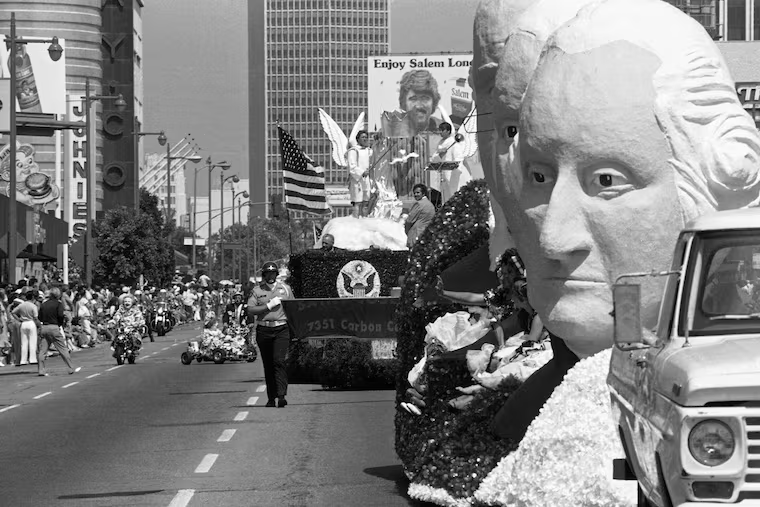
Though much has changed since America’s last notable birthday in 1976, there are many echoes of the Bicentennial’s circumstances and its opportunities in 2026. In yet another time of uncertainty and pessimism, this 250th birthday, like the Bicentennial 50 years ago, offers Americans an opportunity to reconsider their connection to the past and their vision for the future.
Read more How to choose the right wine for frosé, a summertime cocktail staple
Following one of the most fractious decades in American history, the years approaching the Bicentennial were marked by upheaval. In 1973, the OAPEC oil embargo created a gas crisis that contributed to a global recession and inflation as high as 12%. American lost confidence in their leaders, especially after Richard Nixon resigned from the presidency in August 1974, following two years of fallout over the Watergate scandal. The rights revolution of the previous decade brought issues such as race, gender, and sexuality into mainstream media. Countless laws and social norms changed, sparking backlash among conservatives.
These circumstances caused many Americans to wonder what was worth celebrating in 1976. Many marginalized groups questioned whether they should celebrate the Bicentennial at all. A broad array of social and civil rights movements seized on the Bicentennial as an opportunity to challenge the triumphal narrative familiar to so many Americans. Their efforts brought into stark relief the paradoxical relationship between the rhetoric surrounding the nation’s founding and its history of oppression. And the conversations that emerged around confronting this more complicated history shaped the Bicentennial’s commemoration and its longer-term impact.
The circumstances surrounding America’s 250th anniversary are strikingly similar. Political scandals have threatened to engulf the current administration, as the nation has again found itself mired in an unpopular foreign war and a gas crisis, with prices nearly doubling in the last year. Years of inflation have led to a cost-of-living crisis for many Americans. And the last twenty-five years have produced an even greater distrust of institutions such as the government, the media, and the church. A recent Pew Research Center poll shows that nearly 60% of Americans think the nation’s best years are behind us. As during the Bicentennial in 1976, many Americans are again wondering what about the nation’s past and present is worth celebrating.
Challenging circumstances, however, are not unique to the last two anniversaries. In 1876, Americans commemorated the Centennial in the wake of an economic panic in 1873, increased immigration, the end of Reconstruction and the rise of Jim Crow, and a constitutional crisis brought about that year by one of the most fiercely contested presidential elections in the nation’s history. In such circumstances, the 1876 commemorations looked toward the future. They were marked by a growing sense of the United States being poised as an industrial power to take its place on the world stage, and by the efforts of African Americans and suffragists to realize a future of equal citizenship and rights.
In contrast, there was much less enthusiasm during America’s 150th in 1926. With the economy booming, many Americans of the roaring 20s did not need the anniversary. In other words, anniversaries of the Revolution have mattered most during the nation’s most trying times. When the American experiment seems closest to failure, we have used our anniversaries to engage in conversations about the meaning of the past and the future we want to create.
Federal funding also impacts how these anniversaries are celebrated, and in that regard, the Bicentennial and the 250th could not be more different. In the 1970s, the American Revolution Bicentennial Administration gave countless grants to small groups, institutions, and projects across the country. Those grants helped fund local programs, the preservation of local historical sites, and the creation of new sites and museums. In the years leading up to 250, however, there has been a rapid change in the federal funding landscape for historical sites and projects.
Read more Philly’s final World Cup game is going to be hot. Here’s how fans can beat the heat.
Significant cuts to the National Endowment for the Humanities and other agencies have meant fewer grants and resources to support similar local and historical projects like in the years leading up to 1976. As a result, institutions, historical sites, and museums—large and small—have had to take it upon themselves to both produce and fund meaningful programming for the public. From larger institutions like the Museum of the American Revolution to countless institutions in small towns and counties across the country, Americans have been forced to take responsibility for commemorating 250 for themselves and their fellow citizens. But following the model of 1976, they are working to foster conversations about the complexity of the past alongside visions of the future. And as with the Bicentennial, the greatest opportunities for reconnecting with the nation will come from the work done at the local level.
Ultimately, the 250th is not just a historical anniversary; it is a civic opportunity. And that opportunity is not limited to July 4, 2026. Revolutionary anniversaries will continue on the national and local levels for more than a decade, eventually culminating with the bicentennials of the Constitution in 2037 and the Bill of Rights in 2039. And like the bicentennials for those events, these 250th commemorations will provide a platform for Americans to reconsider what the revolution and its ideals mean to them in the present moment. The work done by independent and local institutions and organizations across the country will again give Americans the tools and the impetus to engage with the past in meaningful ways. When we seize those opportunities, we become part of the nation’s long tradition of using our anniversaries of the Revolution to imagine a new and better future.
Michael D. Hattem is the author of The Memory of ’76: The Revolution in American History and is an America250 Media Fellow of the Jack Miller Center.
The “Road to 250” series is an initiative of Historians for 2026, a group of early American academics, public historians, archivists, and educators devoted to shaping an accurate, inclusive, and just public memory of the American Founding for the 250th anniversary.
Made by History takes readers beyond the headlines with articles written and edited by professional historians. Opinions expressed do not necessarily reflect the views of The Inquirer.
Read more South Jersey’s budget winners and losers | Inquirer South Jersey