
Even as it grapples with having less money to award next year, the Philadelphia Cultural Fund on Wednesday announced this year’s grants to arts and culture groups across the city. The fund is dispersing $5.6 million to 322 organizations representing arts and culture of all types, said Cultural Fund executive director Gabriela Sanchez.
Read more We’ve found Philly’s ice cream capital | Let’s Eat
“We have theater, we have dance, we have visual arts, poetry open mics, historic sites, sculpture gardens — it truly ranges across all genres,” Sanchez said.
The 2026 grants also reach beyond Philadelphia’s downtown marquee groups into all sections of the city.
“We are funding Districts 1 through 10, and that is exciting,” she said, referring to the city council districts into which the city is divided.
The Philadelphia Cultural Fund is an important source of money for arts groups, but especially for smaller ones. It is drawing more attention this year after the city’s budget process for fiscal year 2027 left the agency with a cut in funding. Instead of the $5 million it received from the city in FY26, it will now see only $3.5 million.
As a result, it will have to cut the number of grants it gives out in 2027. Although there is currently no specific target for how large that reduction will be, it could mean grants going to 100 fewer groups.
“When you look at 100 organizations that could be funded, that’s terrible, a painful thing to navigate,” said Sanchez. “We have to get creative to find other pathways to meet the need.”
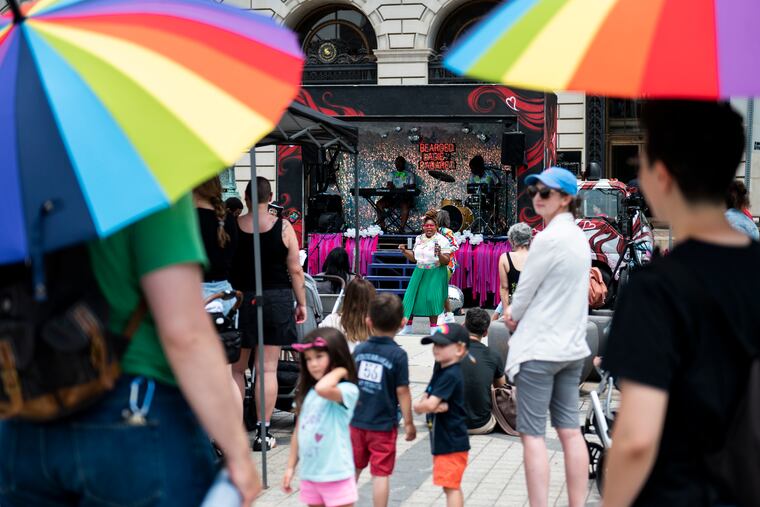
Among this year’s 322 grantees are groups like the Wagner Free Institute of Science, Cambodian American Girls Empowering, Bearded Ladies Cabaret, vocal groups Variant 6 and the Crossing, Shakespeare in Clark Park, the Colored Girls Museum, and the Philadelphia Chinese Opera Society.
In the wider world of arts funding, the grant amounts are relatively modest — either $12,875 or $23,375 — but they are critical to many groups, and the funding can have a compound effect.
Artcinia, for instance, is a small nonprofit with a Center City business address, but the organization brings concerts into a wide swath of neighborhoods — 200 performances in a five-year period, reaching 9,000 audience members in Fox Chase, Nicetown, Hunting Park, Manayunk, and elsewhere, according to a recent summary prepared by the group.
Read more Why the Liberty Bell still rings true
Its largest chunk of revenue comes from foundations, of which the money from the Cultural Fund is a part.
That grant is “significant, about 12% to 15% of our operating budget this year,” said Jake Kelberman, Artcinia’s artistic co-director and director of operations. The group presents music in various genres and has engaged hundreds of professional musicians, and, if the funding disappears, “it’s sad that it’s going to affect the volume of programming we can do,” he said.
Two notable aspects of the Philadelphia Cultural Fund are the fact that it’s money that can be used for general operations (as opposed to being restricted to a specific project, which often requires raising additional money); and that there is no requirement that the money be matched with money from other sources.
These factors makes the kind of funding available from the fund increasingly rare, says Eric César Morales, development director of Movimiento Administradores de Arte en Pensilvania.
“This money from the Cultural Fund is what stabilizes the sector as a whole, because it allows grassroots organizations to become competitive and grow,” said Morales.
Movement of Arts Administrators in Pennsylvania, or MAAP, has often received money from the fund since its inception during the pandemic, Morales said, including $23,375 in this latest round. The money has a salutary effect on the local arts ecosystem; MAAP aims to increase arts access for BIPOC individuals and communities in Pennsylvania by giving Spanish-speaking artists training and resources in navigating the often tricky process of applying for funding.
Morales says that the $1.5 million reduction to the Cultural Fund may not sound like a lot, but with other sources of funding decreasing or threatened, “it’s evidence of a shrinking sector.”
Of the impending city cuts to the fund for FY27, Sanchez said:
“It’s obviously the worst-case scenario that we have to plan for, and I think that it’s also the reality. I hope that people take note of this change and become engaged in the way that they see fit — to talk to their council members around the importance of arts and culture in their neighborhood. That is a form of resilience and also action.”