
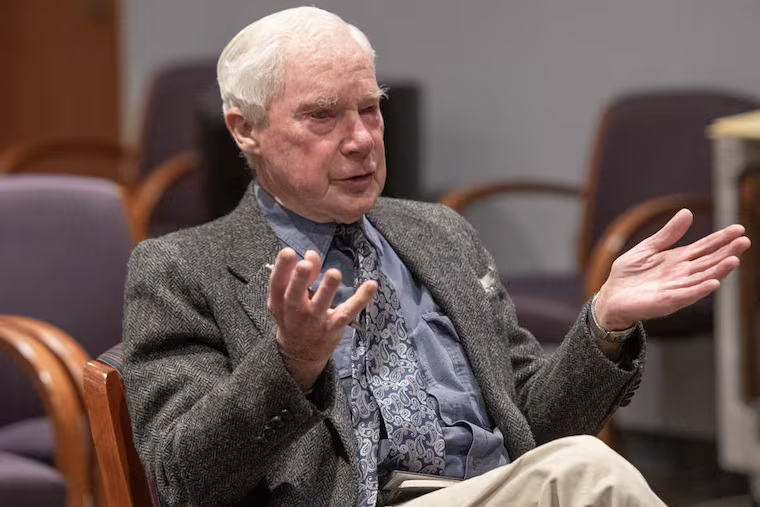
As a resident training atWills Eye Hospital, George Spaeth was perplexed by a seven-year-old patient’s symptoms.
Read more She’s in limbo, he’s in prison | Morning Newsletter
Her legs angled inward, her hair was straw-colored with an odd consistency, and she had intellectual disabilities.
She had come in for faulty vision caused by her lenses — the part of the eye that enables vision by focusing light — becoming loose. Spaeth’s job was to simply prepare her for surgery to remove her lenses.
Yet, he couldn’t help but fixate on the constellation of symptoms she presented with — and the unknown cause underlying them. Nothing in his medical texts fit her profile.
“She didn’t look like anything I’d ever seen before,” he said.
He asked nurses to collect her urine for testing, and discovered it was full of an amino acid called homocysteine.
In 1962, he diagnosed the little girl with a previously unknown rare metabolic disorder called homocystinuria (HCU) — making her one of the first patients in the United States to receive the diagnosis.
An Illinois-based nonprofit dedicated to the disease, HCU Network America, presented Spaeth this month with their HCU Hero Award for his significant contributions to the detectionand treatment of the disorder.
In the fall, the Chestnut Hill resident will also collect a leadership award from the Wills Eye Hospital Alumni Society and the Laureate Award from the American Academy of Ophthalmology.
The honors have giventhe 94-year-old retired ophthalmologist an opportunity to reflect on his decades-long career dedicated to research, finding the humanity in medicine, and emphasizing the importance of humility and curiosity.
“The most important thing that I think any person in any field can do is say I don’t know,” he said.
Solving a mystery
When Spaeth told patients “I don’t know,” he tried to follow up with, “maybe we can find out.”
Through studying the biochemical pathways involved in HCU, he landed on a potential treatment: vitamin B6.
When his patient took it, the homocysteine levels in her urine dropped.
Spaeth was the first to publish on this finding, which led to an uptake in the vitamin’s usage, said HCU Network America emeritus director Margie McGlynn. It works in about 50% of patients with the disorder, and is still used today.
His work also helped spread awareness of the eye symptoms of the disorder, enabling earlier diagnoses.
McGlynn’s sister, who first presented with severe nearsightedness, was diagnosed with HCU in the 1960s by an ophthalmologist who had recently read about the condition in a medical journal.
“I firmly believe that it was Dr. Spaeth’s work and publication on this patient that made this ophthalmologist aware,” McGlynn said.
Spaeth wrote to schools for children with intellectual disabilities and asked if they had any children that fit the symptom profile.
When they sent urine samples, some came back positive for the disorder.
One of the children he diagnosed at Willowbrook State School in Staten Island ended up dying. The boy’s mother told Spaeth she also had a daughter who was two-years-old and seemingly fine.
“We better test your daughter,” Spaeth urged, given that the condition was inherited.
Read more The Small Business Administration is offering new grants and up to $10 million in financing
He examined the boy’s sister, tested her urine, and diagnosed her with HCU.
Spaeth started her on the vitamin treatment at two years old. Without it, she was likely to end up like her brother.
Decades later, he received a call from her mother.
“She was just admitted to medical school,” he recalled her saying.
Finding the humanity in medicine
Growing up, Spaeth dreamed of becoming a poet or composer, “but I’m no Bach, and I’m no Mozart,” he said.
He studied history as an undergraduate at Yale University before pursuing medicine — the same profession as his father, renowned ophthalmologist Edmund Spaeth.
He found he loved connecting with his patients, through finding out what they loved, and what they feared.
“I was a great believer in putting my hand on the patient’s arm while I was talking to them and finding out who they were,” he said.
In his field, glaucoma, he would often see the same patient for two or three decades.
Spaeth operated on a 19-year-old college student suffering from severe headaches in 1969, and has stayed in touch with her ever since.
Over the years, he watched her grow up and marry a wonderful man. When he fell and broke his leg, she came to visit.
“I just think about what that means,” he said.
Spaeth retired from practicing medicine in 2013 to spend time with his wife, Ann, whose breast cancer had returned and stopped responding to treatment. She died that year.
In the years since, Spaeth wrote and published a book for his late wife, Hope for Awareness, about “how lucky I was to be married to an amazing woman, and how unaware I was of how lucky [I was],” he said.
“One of the forefathers”
Janine Tabas, vice chairman of the Wills Eye Alumni Society, described him as “one of the forefathers of glaucoma” and “an absolute gentleman.”
The society honored him with their leadership award in recognition of his lifetime of accomplishments in patient care, teaching, and mentorship, she said.
When Tabas was a first-year resident at Wills Eye in the 1990s, Spaeth served on the senior faculty. She was struck by his humility and the way he treated everyone as equals.
Spaeth invited her whole cohort to his home for dinner, where they sat on his living room floor together. He also asked her to play tennis, knowing that was one of her interests.
“I was a lowly resident,” Tabas recalled. “And here was the chairman of glaucoma. The guy whose name was on every book in the lobby.”
She has since continued Spaeth’s tradition of inviting the residents out to play tennis.
When asked why he thought he was being honored with awards this year, Spaeth pointed to the importance of having humanity and humility and not being “a real jerk.”
“Remember, the most important thing you can do is become a good person,” he said. “If you’re a good person, the likelihood is that you’ll have a good career.”