
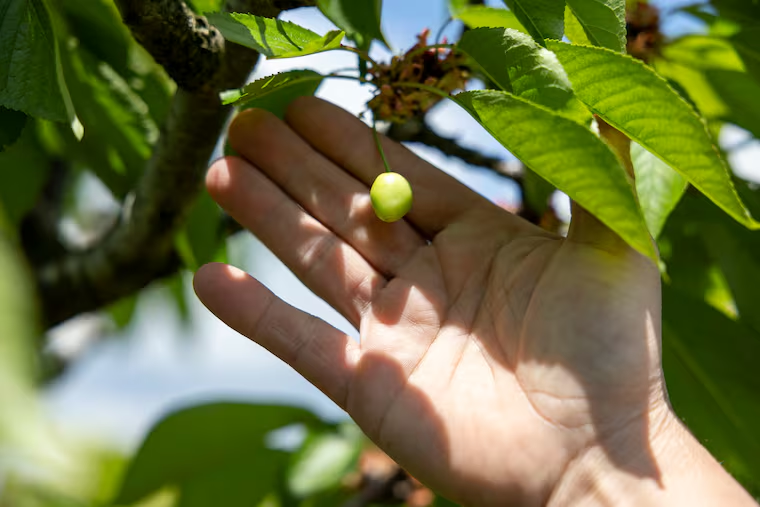
For the second time in five years, a freeze wiped out all of Morgantown farmer Ed Weaver’s peaches this spring.
Read more Philly movers make the impossible happen | Real Estate Newsletter
What was an unassuming late-April frost for most Pennsylvanians this year created devastation for farmers across the state. High temperatures at the beginning of the month accelerated orchards’ blooming process. But an ensuing sudden drop below freezing quickly killed what had grown. The freeze hit 13 states on the East Coast, costing Pennsylvania fruit farmers almost $200 million.
Along with the peaches, the cold decimated nectarines and cherries at Weaver’s Orchard in Berks County. Now, just 15% of the apples and pears there remain, and about half of the berries are gone. Weaver estimates the freeze caused him to lose between 70 and 80% of his orchard’s revenue this year.
Weaver is not alone. A surge in extreme weather has taken a toll on fruit farmers’ crops across the state, in an industry growing increasingly sparse from rising costs.
Weaver — who’s overseen his family’s nearly 100-year-old business for four decades — said many farmers are starting to question whether these losses from extreme weather are the new normal and are determining the best next steps to maintain stability.
“How do we move forward? How are we going to mitigate these risks? And is this a new type of normal for us?” he said.
Attempting to reclaim some of the lost money from the frozen crops, Weaver plans to apply for a Freeze Disaster Assistance Recovery Grant — a $10 million initiative approved last month in the Pennsylvania state budget to assist farmers who have lost 30% or more of their crops.
Pennsylvania Agriculture Secretary Russell Redding said the department is still determining how the funding will be distributed to eligible farmers, but is hopeful the money can be given by fall, when farmers typically see profits from their spring fruit crops.
“We wouldn’t forget about the harm that was done through this frost, and the lingering effects of it. So we’re here to deliver on that promise,” Redding said last month.
The additional state funding comes after Democratic Gov. Josh Shapiro’s administration called for federal assistance to further offset the impact of the freeze. Last month, the United States Department of Agriculture expanded low-interest loan options for some Pennsylvania apple growers with federal crop insurance. Additionally, 17 counties have been designated by the USDA as disaster areas, making farmers there eligible for low-credit loans.
Berks County, home to Weaver’s Orchard, lost 85% of its crops in the freeze. But the county still hasn’t received the federal disaster designation, Weaver said. State officials have said they’re pushing for more assistance.
Weaver said the state’s grant program is a great first step, but that it’ll take years for his orchard to recover from the lost crops, especially for fruit farms that are “at the mercy of the weather.”
He said much of the financial strain is born from input costs that can’t be offset with revenue, like pruning and fertilizer for the decimated crops.
Weaver said his orchard is fortunate to have other sources of income, like its market and storefront, rather than relying entirely on its fruit crops. But the freeze still impacted Weaver’s “pick-your-own” service, where customers can harvest their own fruit, since there are few fruit crops available.
Read more 🌺 Let the luau play on? | Down the Shore
Typically, Weaver said that when farmers’ crops are damaged, they can buy fruit from other growers to sell, but that has become challenging this year, since the freeze was so widespread.
For Norm Schultz, farmer at Linvilla Orchards in Media, the freeze took out nearly all of his peaches and apples.
Schultz said much of his orchard’s rebuilding will rely on the fall season, and how Linvilla’s pumpkin sales fare.
But the harvest lost in the April freeze will have lingering impacts come fall, he said. Apple crops were affected, meaning that candy apple and cider sales could take a hit.
The freeze was the latest blow to rising costs for Pennsylvania fruit farmers, who are contending with unpredictable weather patterns and increasing prices of land.
Both Weaver and Schultz said generationally, it’s becoming harder for farmers to pass down their land to their families, partly because of financial unpredictability, but also because land is worth more if sold instead.
The number of farms in Pennsylvania has fallen by 18% over 10 years from 2012 to 2022, according to the agriculture data.
Schultz said he hopes the state’s newest grant for the affected farmers “can keep the people who only grow fruit in the game, because so many farms and fruit growers go out of business in this area.”
Similarly, Weaver said there’s cost burdens of needing to continually upgrade equipment and make capital investments to maintain facilities, which could reduce profitability and efficiency for future generations.
“If we’re going to have a good food supply of these kinds of crops in Pennsylvania, it needs to be something that the next generation wants to do,” he said. “And if it burns them financially, they’re going to make a decision of whether they want to [farm] or not.”
In the meantime, Weaver said it’s important for people to support local farmers through other means, like purchasing storefront goods or making use of other services.
“Especially right now, it’s so important for people to get out and support the local farms and buy local.”
Natalie Javitt is an intern with the Pennsylvania Legislative Correspondents’ Association. She can be reached at [email protected].
Read more Monroe Township vs. data centers | Inquirer South Jersey