
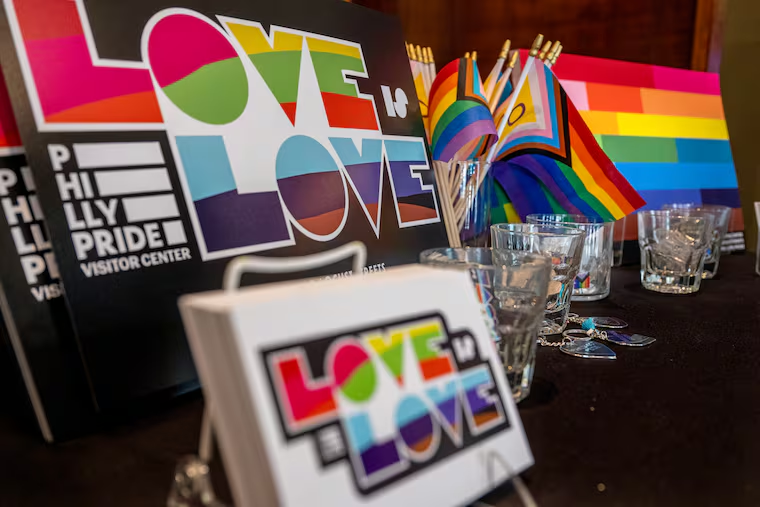
Despite vowing to be “the most pro-gay president in American history,” the Trump Administration has attempted to remove LGBTQ people from public life—banning trans people from the armed forces, stripping funding from research projects relating to LGBTQ people, even removing the Pride flag from the Stonewall National Monument, before a court ordered it restored.
Read more A new iconic library helped the city become more beautiful on this week in Philly history
With all these setbacks, LGBTQ people across the United States might feel like their hard-earned gains of the past century to become full-fledged members of the American body politic are slowly being erased. With the 250th anniversary of the signing of the Declaration of Independence nearly upon us, why might any LGBTQ person take part in celebrating a country that is inhospitable to them and their histories?
The Bicentennial in 1976 offers some answers.
While the scope of the Bicentennial was national, as the cradle of American democracy, Philadelphia was the epicenter of the celebrations. Some 2 million people descended on the City of Brotherly love in early July with events centered on Independence Hall and a newly refurbished Center City, with entertainment including marching bands, cheerleaders, and reenactors in colonial dress. Aiming to celebrate America’s birthday despite the wounds of Vietnam and Watergate still percolating in the public consciousness, organizers of the official festivities hoped to project that America was a liberty-loving nation.
Fifty years ago, many LGBTQ Americans asked: liberty for whom? The answer wasn’t all that encouraging. LGBTQ people had secured fewer rights than we have today and faced even more entrenched homophobia and discrimination. Yet they seized the language of American freedom and insisted that the promise of 1776 belonged to them too.
Rights for gays in the bicentennial year of 1976 were limited, to say the least. That year, same-sex intimacy was legal in just 18 of the 50 states—and not along today’s red-blue state axis. Same-sex intimacy could land a gay man a three-year prison sentence in New York, while 20-year sentences were possible in states like Massachusetts and Nebraska. That year, too, Congress blocked the D.C. City Council from repealing its sodomy law.
Even in states where sodomy laws were not fiercely enforced, communities weaponized general discrimination against gays and lesbians in other ways. Employers denied LGBTQ people jobs, and insurance and credit companies denied coverage, all under the guise that gays might be “admitted law breakers” with “poor moral characters.”
Police also regularly targeted gay spaces. In D.C., police raided cinemas that catered to gay men. And on the morning of July 4, 1976, as Americans across the country donned red, white, and blue and prepared to celebrate 200 years of supposed freedom, police in Galveston, Texas, stormed the Kon-Tiki Baths, popular among gay men, with guns drawn. Police arrested 39 men, charging 20 of them with homosexual conduct and 19 others with indecent exposure, despite it being a private club.
In fact, across the nation that year, gay bars, baths, cinemas, and other spaces faced what activists called a “Bicentennial cleanup,” with cities using the national birthday celebration as a reason to crack down on gay spaces and conduct.
Yet LGBTQ Americans often rejected the exclusion. Washington D.C.’s gay community pushed back against the cleanup efforts and published a full-page guide in The Blade, the city’s gay newspaper, welcoming queer visitors with a list of gay-friendly bars, baths, and restaurants, illustrated pointedly with the image of an American minuteman.
In San Antonio, Texas, gay activists secured a small grant from the National Endowment for the Humanities to hold a seminar “in an atmosphere conducive to frank and sensitive dialog” among gay and straight Texans on community relations. This action sparked an FBI probe into the NEH following angry calls from conservatives.
In Arizona that summer, lesbians sold bicentennial-themed shirts “for the revolution” for $4 apiece, proudly proclaiming the “Stars and Dykes Forever.”
In Los Angeles, gays were divided about whether to celebrate America’s birthday. A group called Stonewall ’76 called out the bicentennial as “a charade” celebrating “corporate bosses” and their “freedom to oppress us.” Conversely, a rival gay rights group, the Christopher Street West Association, opted to march in the city’s Bicentennial parade, behind a banner that read: “We Were There, 1776-1976.”
In Philly, Native American, Black, Puerto Rican, and other activists organized a counter march for the Fourth of July, routing their parade through North Philadelphia and other areas hit by the ravages of deindustrialization and poverty. The city’s Gay Activist Alliance distributed flyers urging the community to “march with the gay contingent” by attending the counter march and “to protest 200 years of gay oppression.” Philadelphia gay activists saw their struggles alongside racial, ethnic, and other economic crises.
And, in Rhode Island, a group calling itself “Toward a Gayer Bicentennial” demanded recognition by the state’s Bicentennial Commission to use the historic Old State House in Providence for a “congress” of gay concerns that summer. The commission refused, arguing that homosexuality was illegal and that gay life had no relationship to the Bicentennial. The group sued in federal court. Gay activists pushed back in the press too. “We were part of this society 200 years ago, and we are part of this society now,” explained Rev. Joseph H. Gilbert of Providence’s mostly gay Metropolitan Community Church.
When the case came before a federal judge, the gay group won. “Does the Bicentennial Commission need reminding,” rebuked U.S. District Judge Raymond Pettine, ‘that, from the perspective of British loyalists, the bicentennial celebrates one of history’s greatest illegal acts?”
There is a central irony for a nation, whether in 1976 or 2026, to celebrate the glories of freedom while trying to crush it for LGBTQ Americans — whether that means raiding gay spaces in 1976 or excluding trans people from government service in 2026. What American democracy and liberation means has been contested since the very beginning of the United States, especially for marginalized people, be they Black Americans or Indigenous people, women, or LGBTQ people. LGBTQ Americans are not a monolith, and each will decide on their own what place they have in this year’s Semiquincentennial.
But 1976 might provide some roadmaps. LGBTQ Americans did not always politely ask to be included in a celebration that rarely made room for them. They appealed to the government through seminars and lawsuits. They published travel guides to better help queer travelers. And perhaps most vividly, they resisted by refusing to be ignored. Those proud Arizonan lesbians donning Bicentennial pride t-shirts are evidence of a queer American community that demanded that their nation live up to the promise of liberty.
LGBTQ Americans did more than demand inclusion. They were insisting, as countless Americans have done over 250 years, that American democracy is unfinished. LGBTQ Americans believed that pushing for the extension of America’s democratic promise was a fulfillment of the nation’s founding. American freedom has always been contested and, as such, remains something that can be expanded. The LGBTQ Americans of 1976 showed us one way to pursue happiness. How will they meet America at 250?
Eric Gonzaba is a historian of race and sexuality in the United States and Associate Professor of American Studies at Cal State Fullerton.
Made by History takes readers beyond the headlines with articles written and edited by professional historians. Opinions expressed do not necessarily reflect the views of The Inquirer.