
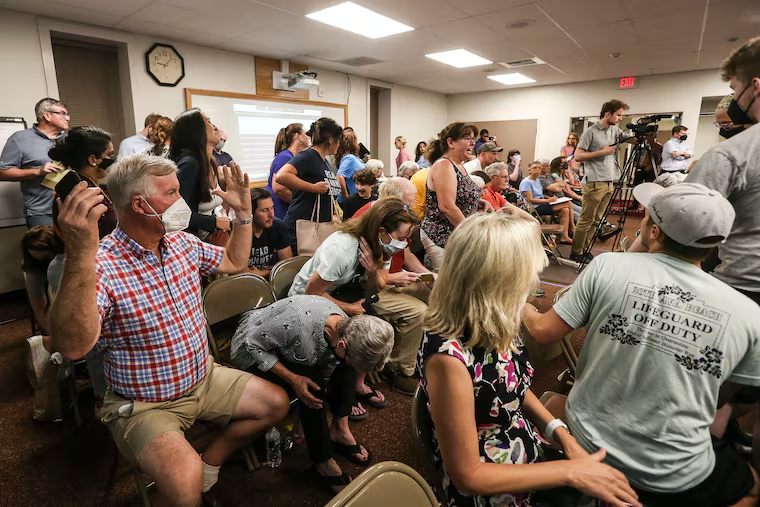
From debates over mask mandates to fights oversexual content in library books, the Central Bucks School District became a poster child for school boards embroiled in culture-war fights in recent years.
Read more 🐕 A day out of the shelter | Morning Newsletter
But it was far from the only district facing conflict. A new national study analyzed how common school-board battles were during the pandemic and the years since — and found they were widespread, particularly in politically divided districts like Central Bucks.
The study, released Friday by the Brookings Institution, also found school boards in 2023 and 2024 were still experiencing higher levels of conflict than they were pre-pandemic.
“There’s been a long tail coming out of the school pandemic conflicts,” said Jon Valant, director of the Brown Center on Education Policy at Brookings. “We’re going to look back at this period of time as being a historically significant one.”
Here are takeaways from the report, and what the fights around school boards could mean for the nation’s education system:
Nearly half of U.S. students attended schools with ‘a lot’ of pandemic-era conflict
Brookings analyzed school board conflicts in two ways: media reports, and surveys of school board members.
Looking at media coverage of a random sampling of more than 2,300 school districts from urban, suburban, and rural communities, Brookings found that between 2018 and 2024, 10% of districts — enrolling 30% of students nationally — had at least one report of a conflict related to masking policies, critical race theory, book bans, or issues involving transgender students.
Based on a survey of school board members from those same districts, however, 47% of students nationally attended districts where board members reported “a lot” of conflict with their communities during 2020-2022, compared to just 8% in the years leading up to the pandemic.
More than 60% of students attended districts where board members reported incidents during the pandemic years — including protests, threats, harassment, or violent outbursts.
That share was higher for politically mixed “purple” districts, which the study found experienced the most unrest: 73% of students in those communities attended districts where board members reported incidents.
School board members in districts representing 43% of students said they had increased security at meetings between 2020-2022; in purple districts, board members representing 62% of students said they had increased security.
The tensions didn’t immediately subside in the wake of the pandemic. In 2023-2024, 18% of students attended districts where school board members reported a lot of conflict — 10 percentage points higher than before the pandemic.
School boards are “really accessible institutions” —providing a forum for public debates around topics like race, gender, and sexuality, Valant said.
Read more 🌺 Build a tropical garden | Outdoorsy Newsletter
The ‘loudest voices’ didn’t translate to more voter turnout
The conflicts, however, didn’t necessarily translate to increases in voter turnout or the number or candidates running for office.
In Florida, an epicenter of school culture-war battles under Republican Gov. Ron DeSantis, Brookings found voter turnout in board elections remained steady during and after the pandemic, even as DeSantis endorsed board candidates and the state passed the “Stop WOKE Act” restricting the discussion of race and gender in schools.
And the share of contested school board races in Florida increased “only slightly, if at all,” Brookings found, despite the presence of parental rights groups like Moms for Liberty, which started in Florida.
Though angry parents confronting school boards were featured in news coverage during the pandemic, some polling has found parents were largely satisfied with their schools’ handling of the crisis, Valant said.
“We can overstate how the public is responding to something when we only hear the loudest voices,” he said.
School board members are nervous about partisan politics
That doesn’t mean recent cultural conflicts haven’t had a lasting impact on school boards, however — or the students they serve.
Board members representing 25% of students reported removing books due to objectionable content, according to Brookings. Those representing 12% of students said they had changed curricula due to objectionable content.
Board members were more likely to report controversy around issues affecting transgender students, like bathroom use and sports participation, than actual policy changes.
Beyond policy, school board members representing 28% of students said culture-war conflicts had impaired their ability to govern, requiring added time and resources, Brookings found.
Most board members surveyed strongly opposed having party affiliations on the ballot, Brookings found. Pennsylvania is one of four states with laws providing for partisan school board elections, according to Ballotpedia.
They also described concern around the impact of divisive national politics on schools, Valant said.
“We heard very clearly from local school board members, they are nervous how much more it’s entering in their work,” Valant said. “Anything we can do to shield school boards and schools from the worst of American politics is a healthy thing.”
Read more The LGBTQ Spirit of 1776 could show the way for this year’s celebrations of freedom