
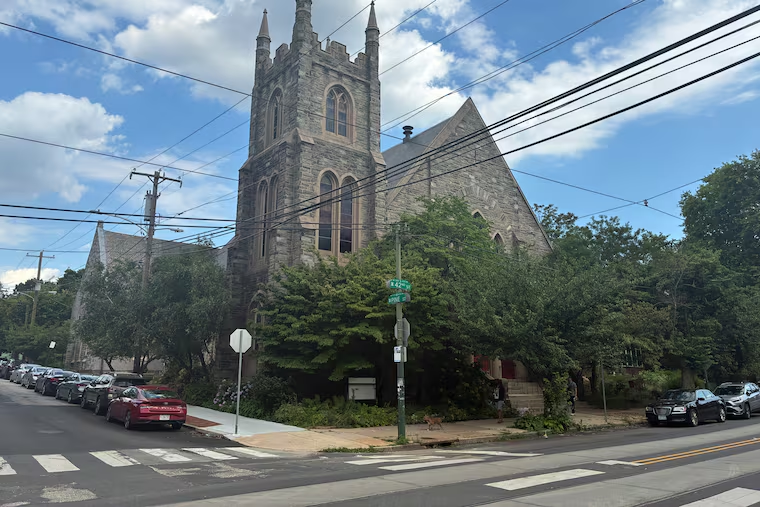
The former Woodland Presbyterian Church at 401 S. 42nd St. is being converted to 35 apartments, mostly studios, with seven set aside at affordable rents.
Read more Conservative education warriors have reshaped GOP politics — even if their crusades often fail
The oldest parts of the church complex date to 1871. But after the COVID-19 pandemic and with a shrinking membership, Woodland Presbyterian merged with several other Philadelphia congregationsin a Center City building.
They decided to sell the 42nd Street building after determining it would cost millions to rehabilitate.
In November the property sold for $1 million to a limited liability corporation that shares the address of Bala Cynwyd-based Finch Development.
The company has extensive rental property holdings in Philadelphia and on its website boasts a 37-unit redeveloped former church building at 1629-39 S. 28th St. in Grays Ferry.
“It was the highest offer, and they did have a track record of one or two conversions of a house of worship,” said David Brindley, a Reformed Church leader involved with the sale. “They seemed to be people that could get things through to the finish line.”
The company did not respond to requests for comment. The project’s design firm is Raymond F. Rola Architecture.
The former Woodland Presbyterian Church is three blocks from the University of Pennsylvania’s campus. At first Brindley sought to interest other congregations, including those who cater to college students, but when those efforts failed, he approached Penn itself in 2024.
The university made an offer in early 2025, he says.
“It could be a space to bridge the gap between the town and the gown, and they were very interested,” Brindley said.
“They were going to make it the new Rotunda,” a Penn-owned community space at 41st and Walnut, he said. “They were going to move the Rotunda and its activities there, the community art space there, and then be able to expand.”
But as 2025 progressed — a year where Penn and the rest of the higher education sector faced federal funding loss and other uncertainty — the university decided against moving forward, citing the expense of shoring up the building, Brindley said.
Read more 🍸 The coolest drink of the Summer of 2026 | Let’s Eat
“I don’t blame Penn at all, but at that time, they just couldn’t [take the] risk,” Brindley said.
The university declined to comment.
Plans on the Department of Licenses & Inspection’s website show units ranging from a smallest of 324 square feet to the largest at 848 square feet, which would be housed in a one-story annex on the south side of the property.
Due to the proximity to the university, Brindley says he expects that renters will mostly be students associated with Penn.
The project falls within Councilmember Jamie Gauthier’s mandatory inclusionary zoning overlay (MIN), which requires that one-fifth of units in large projects be set aside for those earning 40% or less of area median income. That’s roughly $35,000 for a one-person household.
“Project will comply with MIN overlay affordability rules as necessary,” the apartment conversion’s June 25 zoning permit reads.
The project is zoned for duplex construction. But the former church is within the Spruce Hill Historic District, which means that Finch Development can build without a zoning variance — due to a 2019 law passed by City Council that allows historically protected special buildings like churches to be redeveloped beyond their underlying zoning.
The law was created in reaction to the controversy over St. Laurentius Church in Fishtown, where a handful of neighbors fought against the redevelopment for so long that the church deteriorated to the point it had to be demolished.
The Spruce Hill Historic District, like many of the newly created historic districts, is being challenged in court by local property owners, including the major student housing companies in the area like Campus Apartments and University City Housing.
After being rejected by a local judge, an appeal is pending in Commonwealth Court.
“I’m very glad it’s not going to get demolished,” Brindley said. “It’s not a sad story about what the building will become from my perspective. We would have certainly loved for it to have had a community-centered use, but the building was just too far gone.”